
ChatGPT vs Claude vs Gemini: What’s the Difference? (Latest Edition, July 2026)
These days, hardly anyone goes without using at least one AI tool. But getting started can still be daunting.
Should you use ChatGPT? I heard Claude is better, while Gemini is fairly usable for free… I subscribed to all three and compared them firsthand.
To give you the conclusion first, as of July 2026, ChatGPT has reached a level that is more than capable for anyone, Claude remains the favorite among developers for practical work, and Gemini is honestly still one step behind.
There were major changes this month. OpenAI released GPT-5.6 on July 9, and Anthropic’s top-tier model Claude Fable 5 became fully available starting July 1. Meanwhile, Google’s Gemini 3.5 Pro has been delayed until July 17.
Here is a quick overview of what you will get from this article.
- The key differences between ChatGPT, Claude, and Gemini (based on the latest models as of July 2026)
- A comparison in real coding work — benchmarks and developer preferences
- Which AI to choose for each use case
The Three AIs Compared at a Glance
All three offer free versions, while their standard paid plans cost around $20 per month. But the differences become surprisingly large when you look at the tiers above and below them.
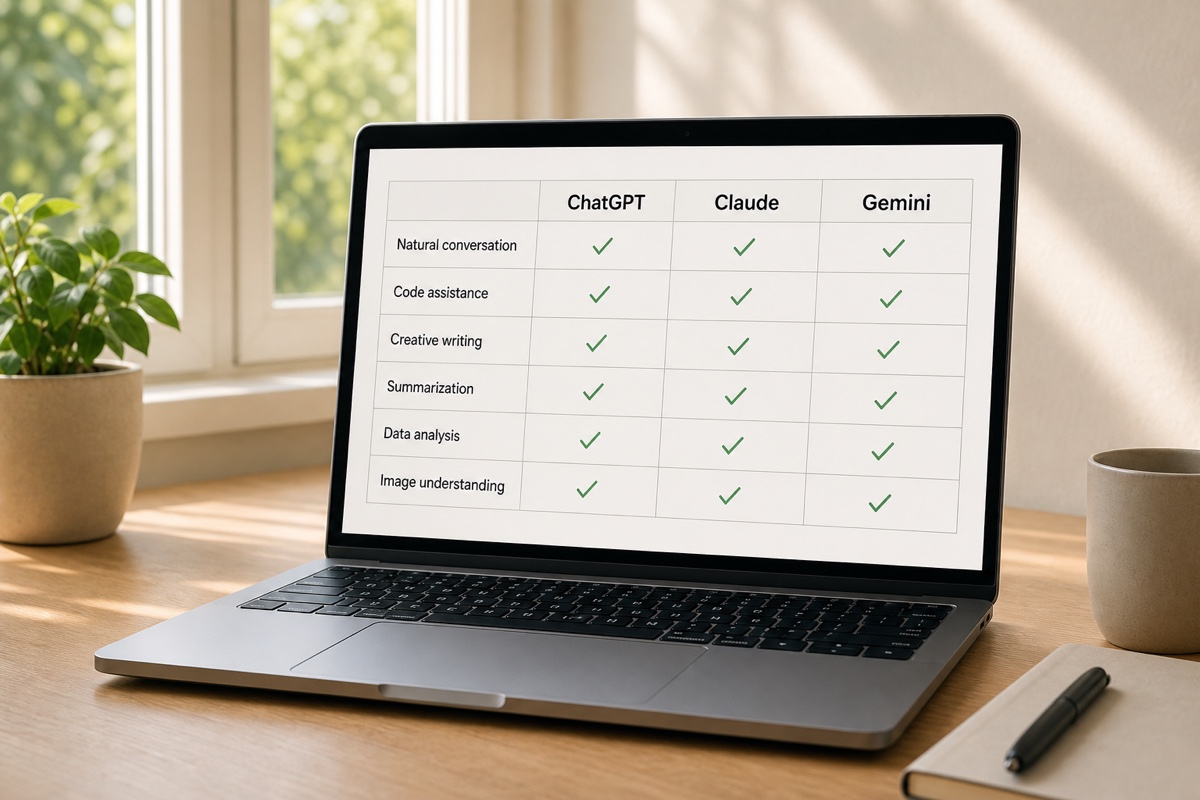
| Category | ChatGPT | Claude | Gemini |
|---|---|---|---|
| Company | OpenAI | Anthropic | |
| Latest model | GPT-5.6 (Sol·Terra·Luna) | Claude Fable 5 | Gemini 3.1 Pro |
| Release date | July 9, 2026 | June 9, 2026 (fully available July 1) | 3.5 Pro delayed until July 17 |
| Entry plan | Go $$8/month | None | AI Plus $$7.99/month |
| Standard plan | Plus $$20/month | Pro $$20/month ($$17/month when billed annually) | AI Pro $$19.99/month |
| Higher-tier plan | Pro $$100–200/month | Max $$100–200/month | AI Ultra $$99.99–200/month |
| Strengths | Versatility, speed, and value | Coding, writing, and reliability | Search and Google integration, free benefits |
Looking only at the standard plans, all three seem similar at $20. The real differences are in the tiers below and above. ChatGPT and Gemini offer entry tiers at $8 per month, making it easy to start casually, while Claude’s paid plans begin at $20. At the other end, higher plans for heavy users converge at roughly $100–200 per month across all three services.
In 2026, choosing an AI is less about performance rankings and more about how well it fits your work.
ChatGPT — The All-Rounder That Has Moved Beyond “Good Enough”
ChatGPT is still the AI used by the most people. Since GPT-5.6 was released on July 9, its capabilities have improved enough to shed the “decent at everything” label.
GPT-5.6 is split into three models by performance: Sol, Terra, and Luna. The top-tier Sol delivers state-of-the-art results in coding, knowledge work, and science while using fewer tokens and costing less. Its API price is half that of Claude Fable 5.
Image generation, voice conversations, data analysis, and custom GPTs are still available in one app. I usually recommend ChatGPT first to people new to AI because there is an overwhelming amount of Korean-language material, so answers are easy to find when you get stuck.
- Recommended for: AI beginners, people who want many features in one place, and those who prioritize value
- Downside: Questions remain about its real-world reliability relative to benchmark scores (the evaluator METR identified GPT-5.6 Sol’s “reward hacking” rate as the highest among publicly available models)

Claude — The AI Developers Choose for Practical Work
Claude is an AI created by Anthropic, known for handling long-form text and coding.
Claude Fable 5 is the highest-tier model Anthropic has ever released publicly. Access was briefly restricted after its June 9 release because of U.S. government export controls, but it reopened worldwide on July 1.
When you use it yourself, its writing is noticeably natural. I was highly satisfied with it for work where writing quality matters, such as report drafts, blog posts, and emails.
I will cover coding in more detail below, but among developers it has effectively become the standard.
- Recommended for: developers, working professionals who write, and people who regularly handle long documents
- Downside: The most expensive API pricing of the three, with a relatively limited set of additional features compared with ChatGPT
Gemini — Google’s Ecosystem Is Powerful, but It Is Still One Step Behind
Gemini’s greatest strength is Google. AI is embedded in services you already use, from Search and Gmail to Google Docs and YouTube. Its generous free version remains another advantage.
However, to be frank, it is currently trailing in the model race as of July 2026.
While competitors released GPT-5.6 and Claude Fable 5, Google delayed its next model, Gemini 3.5 Pro, until July 17 while overhauling its architecture. The best model currently available is Gemini 3.1 Pro, which trails both competitors on coding benchmarks (Gemini 3.1 Pro 54.2% vs Claude Opus 4.8 69.2% on SWE-bench Pro).
Of course, its unique strengths—Google service integration, long context, and free benefits—remain valid. The landscape could shift again once 3.5 Pro arrives.
- Recommended for: people who use Google services extensively and those who want to start for free
- Downside: Falling behind in the latest model race, with a particularly large gap in coding performance
How Do They Perform in Real Coding? — Benchmarks and Developer Sentiment
Coding is the hottest area in AI selection these days, so I have summarized it separately.
The benchmarks are closely matched. On SWE-bench Pro, which measures the ability to solve real GitHub issues, Claude Fable 5 ranks first among publicly released scores at 80.3% (OpenAI has not published Sol’s score). On Terminal-Bench 2.1, which measures command-line skills, GPT-5.6 Sol leads Claude Fable 5 (83.4%) with 88.8%.
But developer sentiment favors Claude. In a developer community survey, OpenAI Codex led by simple vote count at 65.3%, but weighting highly recommended responses flipped the result, giving Claude 79.9% preference. In other words, Codex gets many votes because it is used daily, but Claude overwhelmingly won the more considered answers about which tool is better.
In professional use, Claude Code is also considered the coding agent with the most large-enterprise adoption cases. It is common to use OpenAI tools for fast autocompletion and leave serious work—finishing code and pushing it to a repository—to Claude, hence the saying, “Codex for typing, Claude Code for commits.”
Gemini CLI is a good entry point because its free usage allowance is generous, but as noted above, its coding performance has not yet reached the level of its two competitors.
Here is the summary.
- Coding benchmarks: Claude and ChatGPT split first place by category, while Gemini has a gap to close
- Developer preference: Claude leads among professional developers and enterprise deployments
- Value: ChatGPT costs half as much on an API basis, making it better for high-volume use
So Which One Should You Choose?
After using all three, this is the conclusion I reached.
- If you are just starting: ChatGPT (abundant resources and varied features, with top-tier performance now)
- If you are a developer or writing is your main job: Claude (number one among developers, with strong writing quality)
- If you use Google services or want a free option: Gemini (integration and free benefits, though performance is still one step behind)
Let me organize a few common questions in a Q&A.
Q. Is the free version enough? For asking light questions and getting answers, the free versions of all three are sufficient. If the free tier feels limiting but $20 is too much, you could start with an $8/month tier such as ChatGPT Go or Gemini AI Plus.
Q. Do I need to subscribe to more than one? Most people only need one. However, many developers do use two in practice: “Claude for coding, ChatGPT for everything else.”
Q. Do the performance rankings change often? Yes, they can reverse every few months. Even this month, GPT-5.6 was released and Gemini 3.5 Pro is still pending. Choosing the one that fits your use case will serve you longer than chasing rankings.
Wrapping Up
There is no single right answer when choosing an AI, but there are wrong answers. One is choosing something that does not fit your needs simply because others recommend it.
Start by asking all three the same questions using their free versions. After a week, the AI that suits you will naturally become clear. 😊
References
- GPT-5.6: Frontier intelligence that scales with your ambition | OpenAI
- OpenAI launches its new family of models with GPT-5.6 | TechCrunch
- Claude Fable 5 and Claude Mythos 5 | Anthropic
- Claude Fable 5 vs GPT-5.6: Coding Benchmarks (2026)
- Google Delays Gemini 3.5 Pro Launch to July 17
- Every AI Coding CLI in 2026: The Complete Map | DEV Community