The question “Which should I subscribe to, Claude or ChatGPT?” can no longer be answered by comparing model performance alone. As of July 2026, the top models on both sides (Claude Fable 5 and GPT-5.6 Sol) score 60 to 59 on overall intelligence—effectively a tie. The difference lies not in the models but in the ecosystems. They differ in what they can create and what they cannot do at all.
This article minimizes coding benchmark coverage (that was covered in the earlier Claude Code vs Codex article) and compares the two ecosystems across real-world use cases: image generation, design, writing, and agents.
Here is the key summary.
- ChatGPT wins decisively at image generation. Claude has no image-generation capability at all.
- Claude leads in UI design. Its approach is to create deployable HTML/CSS instead of an image.
- For writing, choose Claude for long-form and document work; choose ChatGPT for general-purpose work involving search and multimodality.
- The conclusion is simple: Claude for developers, ChatGPT for everyone else.
A brief look at models and pricing
| Category | Anthropic (Claude) | OpenAI (ChatGPT) |
|---|---|---|
| Top model | Claude Fable 5 (released in June) | GPT-5.6 Sol (released in July) |
| API price (per 1M tokens) | $10 / $50 | $5 / $30 |
| Subscription plan | Pro $20 / Max $100·$200 | Free / Go $8 / Plus $20 / Pro $100·$200 |
| Includes the top model | Temporarily included through July 19; separate credits thereafter | Included |
The last row is the one that stands out. Fable 5 is included with the subscription only through July 19 (a deadline extended twice), and from July 20 onward you must purchase credits separately. Anthropic says access will be restored once capacity is available, but that promise has no deadline. For “access to the top model,” OpenAI is ahead. Including the free tier and $8 plan, ChatGPT clearly has the lower barrier to entry.
Image generation: an area where comparison does not apply
First, one fact must be clear: Claude cannot generate images. It can read and analyze images, but it has no means to respond to requests to draw one.
By contrast, OpenAI’s GPT Image 2 (released in April) currently dominates the image-generation leaderboard. It ranks first in the blind-vote-based Image Arena with an Elo rating of 1,339, supports 2K resolution and multilingual text rendering including Korean, and even offers a thinking mode that infers composition, lighting, and text placement before drawing.
If you have even one task that requires visual output—thumbnails, marketing visuals, or presentation illustrations—that alone justifies a ChatGPT subscription.
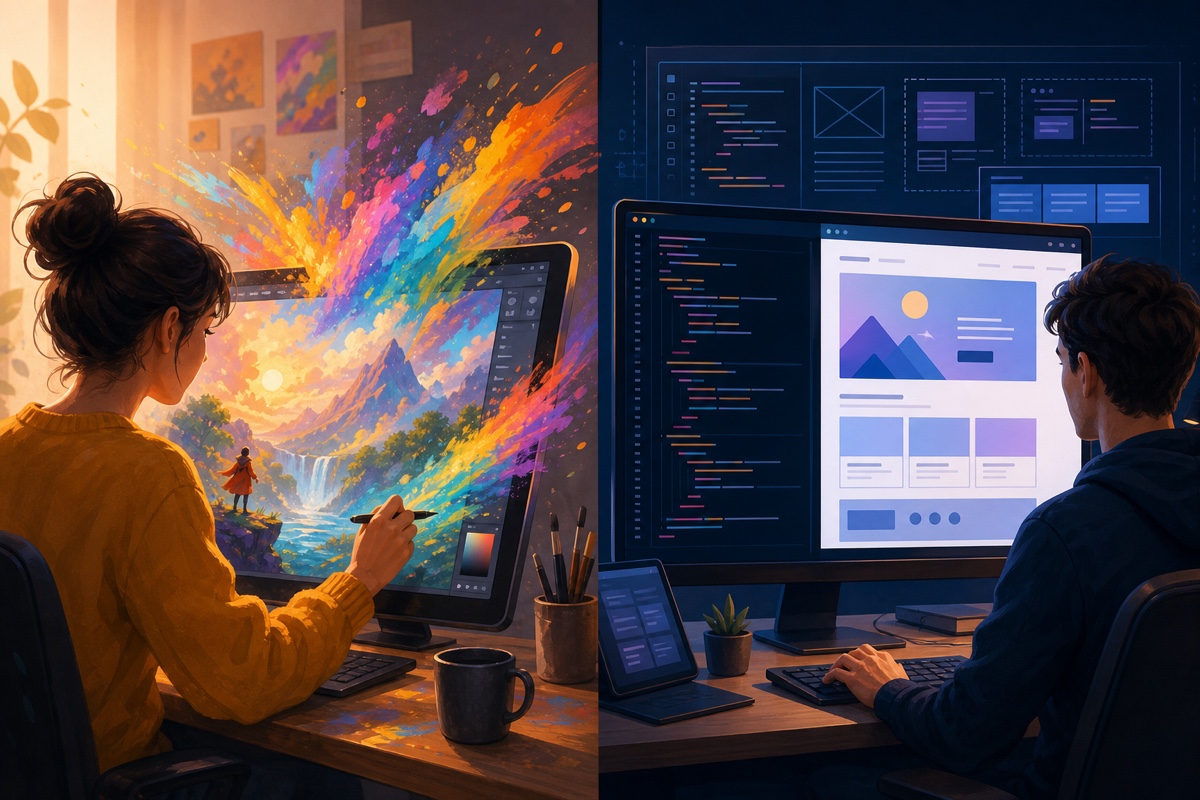
Design flips the result: the answer is code, not an image
But switch the category to “design,” and the winner changes. The difference in the companies’ approaches is interesting: OpenAI answers design requests with images, while Anthropic answers with working HTML/CSS prototypes.
In UI-generation comparisons, Fable 5 is even called “the final boss of the UI space.” Many reviews say GPT-5.6 has narrowed the aesthetic gap considerably, but the consensus is that Fable 5 still leads in accurately following a design brief and in one-shot quality. It can produce a multiscreen prototype with micro-animations in a single pass.
In practical terms, the split is straightforward. When you need a concept image for planning or sharing a mood board, GPT Image 2 is faster. When that concept must ultimately become code, starting with Claude and generating the prototype saves a step.
Writing and document work
Claude remains stronger for long-form work. This is especially true for reports, technical documents, and long drafts that must preserve their structure, as well as workflows that use a 1M-token context to process multiple documents in full.
ChatGPT competes through surrounding features rather than writing quality alone. Search integration, image generation, voice, and the work-focused agent announced in July (ChatGPT Work) provide broad capabilities in one account. If your workflow moves from writing to adding illustrations and searching for sources, not having to switch tools matters.
Conclusion: your profession decides
To summarize, the winners by area are as follows.
| Area | Winner | Basis |
|---|---|---|
| Coding (solving real-world issues) | Claude | SWE-Bench Pro 80.3% vs 64.6% |
| Coding (terminal automation) | ChatGPT | Terminal-Bench 2.1 88.8% vs 83.4% |
| Image generation | ChatGPT | Claude has no capability |
| UI design and prototyping | Claude | One-shot quality and brief adherence |
| Long-form and documents | Claude | 1M context and structural consistency |
| Versatility and price accessibility | ChatGPT | Free tier, $8 plan, and integrated features |
One line runs through this table: the closer the output is to code, the more Claude wins; the farther it is from code, the more ChatGPT wins.
That is why the conclusion depends on your profession. For developers, it is Claude: you get a real-world coding advantage plus design prototypes as code, while image generation is needed less often than you might think. For non-developers, it is ChatGPT: images, search, voice, and agents are included in one subscription, with a free starting point, while Claude’s strength—code output—is rarely useful.
Of course, the most common practical answer is to use both. Subscribe to one as your primary service and supplement it with the free tier or cheapest plan for the other; for $28 per month, you can get the strengths of both ecosystems.