
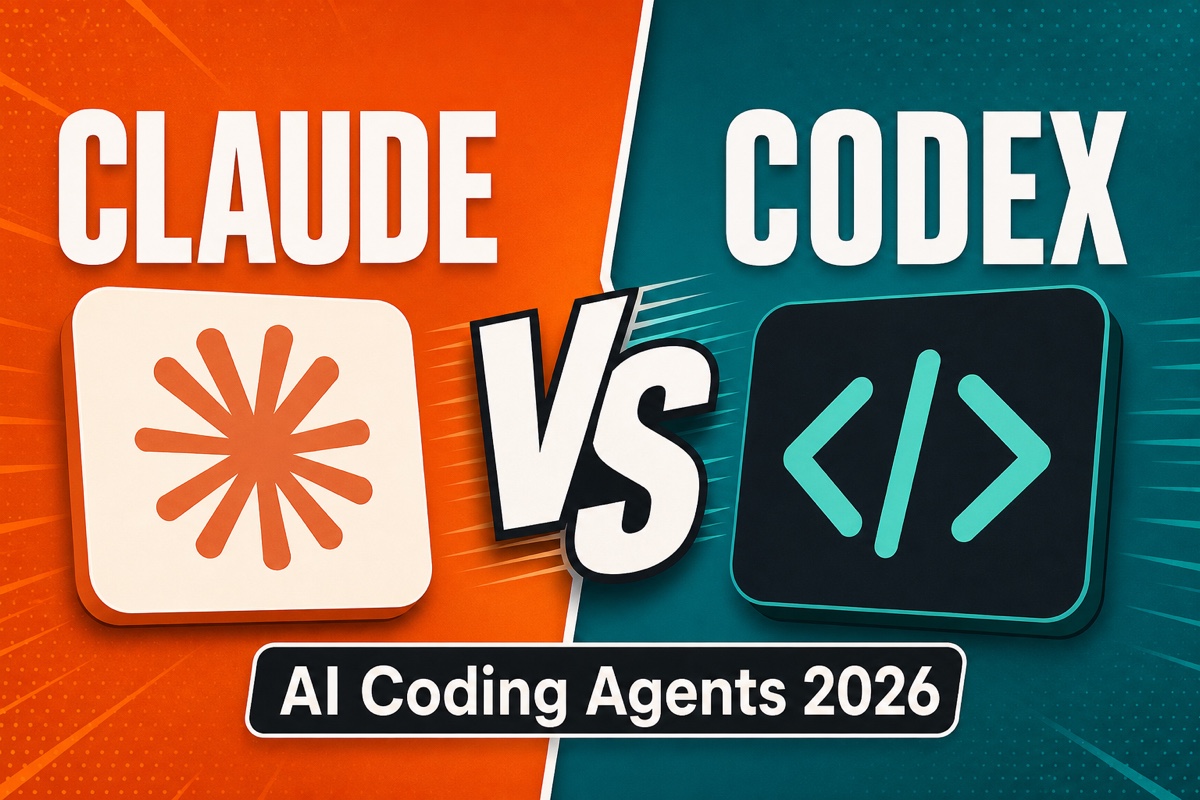
A developer’s conclusion after using Claude for a year and Codex for six months
One of the questions developers ask most often in communities these days is, “Which should I use, Claude Code or Codex?” I’ve paid for Claude for about a year and Codex for more than six months, using both every day, including the recently released Claude Fable 5 and GPT-5.6 Sol. Before settling on these two, I also tried Cursor and Kiro. Cursor was genuinely impressive at first, but I naturally moved over because Claude was so good. Kiro is a decent tool, but as a relatively niche product, its ecosystem of skills and plugins isn’t as mature. And since I would end up using Claude models inside Kiro anyway, I didn’t see much reason to go through it. In this article, I’ll organize the differences I’ve experienced firsthand, along with objective material such as community surveys, benchmarks, and GitHub issues.
The difference in character I felt between the two agents
In one line: Claude feels like a senior developer who is broadly good at everything, while Codex feels like a quiet but precise colleague.
Claude Code is relatively fast and accurate. It has a strong feel for understanding a codebase and reading context, so it picks up your intent even when your instructions are ambiguous. But it does make mistakes occasionally. It has exactly the senior-developer tendency to charge ahead confidently and miss details. Its large user base also means its surrounding ecosystem of skills and plugins is a significant advantage. Search for the workflow you need, and someone has probably already built it.
Codex doesn’t write code as quickly or as boldly as Claude. But it is accurate. It takes longer to think, and the result leaves fewer gaps.
What’s interesting is that this isn’t just my impression. In a Reddit survey with more than 500 participants, 65% preferred Codex for everyday use, while 67% judged Claude’s code cleaner in a blind code review. Overseas communities commonly say that “Claude is strong at precision editing, while Codex is strong at broad refactoring” and that “Codex is slower but more thorough on complex tasks.” That almost exactly matches my experience.
Claude Fable 5: the shortcomings have largely been resolved
Claude Fable 5, released in June 2026, has personally been very satisfying. The main weakness of earlier Claude versions—the fact that they were “fast but occasionally mistaken”—has almost disappeared.
The numbers confirm it. Fable 5 scored 95% on SWE-bench Verified and 80.3% on SWE-bench Pro. Opus 4.8, the previous top model, scored 69.2% on SWE-bench Pro, so that is an increase of more than 11 percentage points. On the difficult FrontierCode Diamond, it scored 29.3%, more than twice Opus’s 13.4%. Stripe said it completed a migration of a 50-million-line Ruby codebase with Fable 5 in one day—work that would have taken more than two months by hand. These benchmarks are based on Anthropic’s own scaffolding and have been criticized for not using a neutral harness, so they are best viewed as a trend rather than as absolute figures.
GPT-5.6 Sol: a fatal blemish with its token issue, yet still outstanding
GPT-5.6 Sol, released by OpenAI on July 9, is also an outstanding model. It set a new record with a score of 80 on Artificial Analysis’s Coding Agent Index. However, reports began pouring in immediately after launch that “the usage limit is disappearing at an insane rate.” I experienced it too, and digging into the details reveals fairly specific evidence.
- GitHub issue #32250 in the Codex repository reports that when a Pro subscriber gave GPT-5.6 Sol Medium a short task, the remaining five-hour allowance dropped from 87% to 76%—11 percentage points in a single operation. After that, even minor follow-up questions without tool calls consumed about one percentage point each. It was being depleted faster than the same user’s GPT-5.5 xhigh.
- Issue #31860 confirmed that the Codex app was using Sol with a 372K context, about 35% of its 1.05M-token specification. When the context reached 90%, early compaction occurred, and this reprocessing may have accelerated token consumption further.

OpenAI ultimately acknowledged that it had “made the highest-compute setting too easy to use without adequately communicating its impact” and reset the rate limit twice within 24 hours. According to an OpenAI representative, Sol Medium 5.6 is not in the same class as 5.5 Medium; Sol Low is the default, and xhigh should be reserved for genuinely difficult problems. In other words, this appears less like an intrinsic inefficiency per token than a combination of UX issues that made high-compute settings feel like the default and bugs in the app. OpenAI claims that Sol’s maximum reasoning reduced output tokens by 54% compared with competing models.
It was a serious blemish, but the model itself is still remarkably capable. Once you understand the settings, its output accuracy remains top-tier.
There is no longer any need to insist on Claude
Until a few months ago, there was a widespread feeling that “Claude was the only choice for coding.” I don’t think that is true anymore. Both are excellent. Codex CLI took first place on Terminal-Bench 2.1 with 83.4%, while Fable 5 leads SWE-bench Pro with 80.3%. We are in an era where the winner changes from benchmark to benchmark.
That leads to my conclusion: using both is best. But if I had to choose only one, I would choose Codex. I already use ChatGPT frequently, and the same subscription also covers image generation. The point is that this is the better choice when you consider the value of the entire subscription, rather than looking only at one coding agent.
Won’t everyone end up using both anyway?
I want to add one more perspective. Recent models are consuming dramatically more tokens. One analysis says agentic AI can consume up to 1,000 times as many tokens as ordinary chatbot use. Forbes and TechCrunch have called this phenomenon “Tokenpocalypse” and reported a sharp increase in users exhausting their subscription limits sooner than expected. In fact, the biggest reason people in the community subscribe to Codex as well is that “the Claude limit runs out too quickly.”
If one subscription’s allowance is no longer enough, I suspect everyone will naturally converge on using two subscriptions in parallel.
Using both agents together also improves performance
Using both is not simply about limits. When I tried AI orchestration, having different agents interact performed better than attaching two identical agents.
Research supports this as well. The X-MAS study (arXiv 2505.16997) reports that assigning different LLMs to different roles in a multi-agent system improves accuracy by 8–47% over homogeneous combinations. Another study (arXiv 2602.03794) found that two diverse agents can match or outperform 16 homogeneous agents.
The combination that worked best in my experience was this: have Claude do the work and Codex review the result. It is a setup where a fast, bold senior produces the output and a cautious, precise reviewer filters it. Because their characteristics differ, they catch each other’s blind spots well.

Summary
- Claude has a fast and accurate senior style; Codex is slower but precise. Community opinions are consistent with this.
- Fable 5 addresses Claude’s main weakness—occasional mistakes—while GPT-5.6 Sol remains highly capable despite its token issue.
- There is no longer any need to insist on Claude. Both are top-tier, and using both is best.
- If I had to choose one, I would choose Codex because of the value of a subscription that also includes ChatGPT and image generation.
- Given the surge in token consumption, won’t everyone eventually use both?
- Heterogeneous combinations are the answer for orchestration. The combination that worked best was Claude creating and Codex reviewing.
References
- GPT-5.6 Sol usage depletion issue (openai/codex #32250)
- Sol context cap issue in the Codex app (openai/codex #31860)
- Claude Fable 5 & Mythos 5 benchmark analysis (Vellum)
- Claude Code vs. OpenAI Codex comparison (Composio)
- Codex vs. Claude Code comparison (Builder.io)
- X-MAS: heterogeneous LLM multi-agent study (arXiv 2505.16997)
- Agent diversity scaling study (arXiv 2602.03794)
- Report on accelerating AI token depletion (Forbes, 2026.4)
- The era of token-cost bills (TechCrunch, 2026.6)