
![Cover image for [Claude Code #8] /model·/effort·/fast, Tuning AI Performance](/assets/images/posts/14cb9846-dbec-4d11-ad84-fb58e3794cba/claude-code-model-effort-fast.jpg)
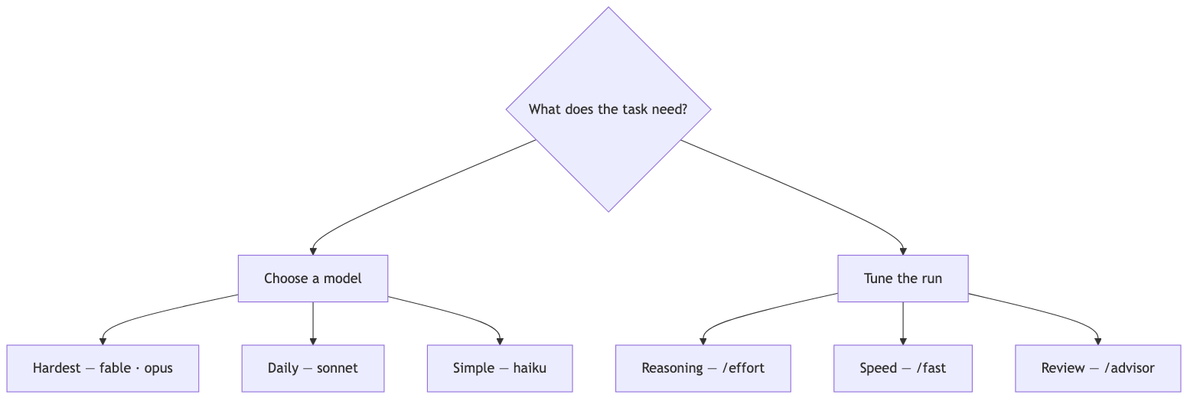
Claude Code has four dials for controlling speed, quality, and cost: /model, /effort, /fast, and /advisor.
Their roles differ in subtle ways, so they are easy to confuse. This installment brings them together in one place.
If Claude Code, Part 7 was about increasing the number of workers, this installment is about tuning each worker’s performance.
/model: Which model does the work
/model changes the session’s primary model. Using an alias instead of a version number is convenient.
The main aliases under Official model configuration documentation are as follows.
fable: the top-tier model for the most difficult, time-consuming workopus: for complex reasoning taskssonnet: for everyday coding taskshaiku: a lightweight model for simple tasksdefault: clears the override and returns to the account’s recommended value
Entering only /model opens the picker. Press Enter to save the selection as the default, or s to apply it only to the current session.
If you change the model after a conversation is underway, the next response rereads the entire history without the cache. That is why the picker asks for confirmation once.
/effort: How deeply should it think
/effort sets the model’s adaptive reasoning intensity. Lower levels are faster and cheaper; higher levels think more deeply.
There are five levels: low, medium, high, xhigh, and max. Supported levels vary by model, and Haiku does not support effort at all.
If you select an unsupported level, it falls back to the highest supported level below it.
The default is high for most models. max provides the deepest reasoning but applies only to the current session.
The menu also includes ultracode. It is a Claude Code configuration that sends xhigh to the model while running a multi-agent workflow for substantial tasks. It is session-only as well.
/fast: Run the same model faster
/fast is a toggle that runs Opus up to 2.5 times faster (research preview).
The important point is that the model does not change. As Official fast mode documentation states, the same Opus runs in a speed-prioritized configuration, so quality stays the same while the per-token price increases.
- Supported models: Opus 5 and Opus 4.8 (Sonnet and Haiku are unsupported; enabling it on another model automatically switches to Opus)
- Pricing: based on Official fast mode documentation, input $10 · output $50 (per million tokens)
- Subscription plans (Pro·Max·Team·Enterprise) require usage credits to be enabled (Team·Enterprise also require administrator activation)
There is one pricing trap. If you enable it midway through a conversation, the entire context up to that point is reprocessed once at the fast-mode rate. If you plan to use it, enabling it at the start of the session is cheaper.
While it is enabled, a ↯ icon appears next to the input field.
/advisor: Use a stronger model only at decisive moments
/advisor is an Experimental feature that attaches an advisor to the main model.
Before deciding on a direction, when the same error keeps recurring, or before declaring completion—at moments like these, Claude automatically consults a stronger model. The advisor model receives the entire conversation and returns its advice.
/advisor opusThere is one rule: the advisor must not be weaker than the main model. Sonnet as the main model with Opus as the advisor is a typical combination, while a Fable main model can receive advice only from Fable.
With API billing, the advisor is charged at its own rate; with a subscription plan, it consumes plan usage. Even so, because it is called only at decision points rather than every turn, it is usually cheaper than running a stronger model continuously.
Recommended combinations by situation
- Everyday coding: sonnet + the default effort. Add opus through advisor if needed
- Difficult design·long autonomous tasks: fable or opus + high or above
- Urgent iterative fixes·live debugging: fast mode + low effort
- Simple batch tasks: haiku (effort is unsupported, so use it as is)

Summary
/model determines who works, /effort how deeply to think, /fast how quickly to respond, and /advisor when to ask a senior model.
The four are independent dials, so you can combine them freely. Adjust them to match the nature of the task.
The next installment covers /code-review for maintaining code quality. I’ll summarize the differences between review intensities, from low to ultra.
Sources and verification criteria
- Claude Code official documentation — Model configuration (Anthropic, checked 2026-08-14)
- Claude Code official documentation — Fast mode (Anthropic, checked 2026-08-14)
- Claude Code official documentation — Advisor tool (Anthropic, checked 2026-08-14)
Continue reading
Claude Code series
- Previous installment: [Claude Code #2] /plan planning mode: agree on the design before making changes
- Previous installment: [Claude Code #1] /init: Get started by automatically generating CLAUDE.md