
![Cover image for [Swift Intermediate #8] Swift KeyPath explained: how map(\.name) works](/assets/images/posts/ed14abe4-909b-4e97-9896-8e26955ce9e6/swift-keypath-1.jpg)
users.map(\.name). This is a familiar one-liner in modern Swift code. Ask what the backslash-prefixed \.name is, and you will often hear, “Isn’t it shorthand syntax for map?” That is only half right. It is a value of the independent KeyPath type. This works not because map is special, but because KeyPath can stand in for a function.
This is the eighth and final article in the intermediate series. We will clarify what it means for KeyPath to “turn property access into a value,” compare the three KeyPath types, and examine where they prove useful in production.
What Is KeyPath? — Turning a Path to a Property into a Value
In the closure article, we saw the power of treating functions as values. KeyPath applies the same idea to property access. From the access operation user.name, it removes user and keeps only “the path to .name,” turning that path into the value \User.name.
let path = \User.name        // KeyPath<User, String>
let user = User(name: "Kim", age: 30)
let name = user[keyPath: path]   // "Kim"
The type signature reveals the essence. KeyPath<User, String> is “a path that starts at User and ends at String.” Because it is not yet tied to any instance, you can store it in a variable, pass it to a function, or collect it in an array. Its decisive difference from dynamic languages that access properties with string keys such as “name” is type safety. A typo such as \User.nmae is a compile error, and both endpoint types of the path are checked at compile time. It brings the work done by Objective-C’s KVC (Key-Value Coding) string keys into the type system—a return to the safety-first philosophy from part 1.
Paths can be chained. A nested property can be traversed with \User.address.city, and the chain can continue into a standard-library property with \User.name.count. You can also join two paths at runtime with appending(path:).
KeyPath in a Function Position — How map(.name) Works
users.map(\.name) compiles because of Swift Evolution proposal SE-0249. When you pass KeyPath<Root, Value> where a (Root) -> Value function is expected, the compiler automatically converts it into the { $0[keyPath: path] } closure. That is why the two lines below are equivalent.
let names = users.map { $0.name }
let names = users.map(\.name)
Which is better? For simple property extraction, the consensus favors KeyPath. { $0.name } requires three steps: “read the closure → determine what $0 means → realize that it extracts one property.” With \.name, “extract name” is the syntax itself. It is an even more compressed form of the intent declaration discussed in the higher-order functions article. Conversely, if any transformation logic is involved ($0.name.uppercased() + "님"), use a closure. KeyPath is for extraction, not transformation.
This automatic conversion works anywhere a function is accepted, not only in map: filter(\.isActive), compactMap(\.thumbnail), KeyPathComparator used with sorted(by:), and even contains(where:). Recipes for higher-order functions become one step shorter when combined with KeyPath.
Three KeyPath Types — Read-Only or Writable?
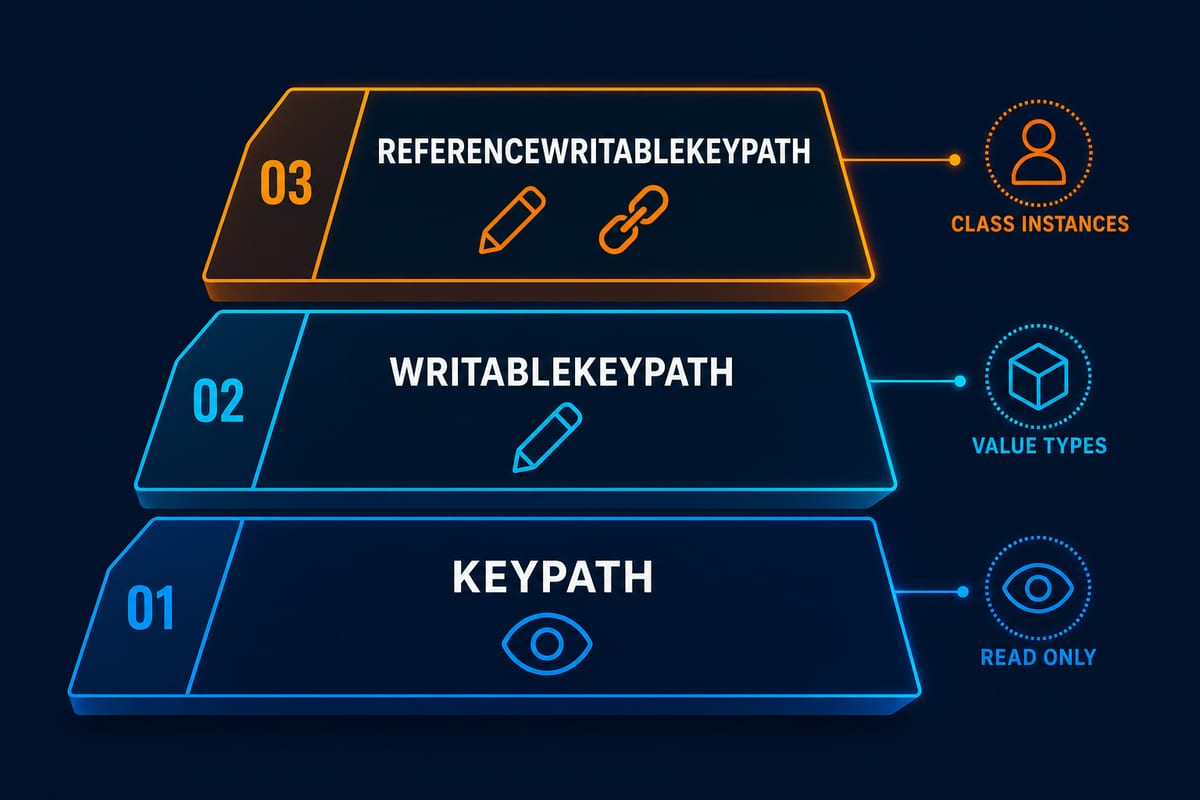
KeyPath has a hierarchy. The compiler creates different types depending on the access permitted by the path.
KeyPath<Root, Value> — read-only. It is a path to a let property or a read-only computed property.
WritableKeyPath<Root, Value> — readable and writable. It is a path to a var stored property or a computed property with a setter, allowing value-type properties to be modified through the path.
ReferenceWritableKeyPath<Root, Value> — writable through a reference. It is a path to a var property on a class instance. The value-versus-reference semantics—that the contents can change even when the reference is held with let—are reflected in the KeyPath types as well.
This distinction matters in production when you write code that changes a value through a path.
func update<T, V>(_ items: inout [T], path: WritableKeyPath<T, V>, to value: V) {
    for i in items.indices {
        items[i][keyPath: path] = value
    }
}

update(&cells, path: \.isSelected, to: false)   // Deselect all⟧
Passing a read-only KeyPath results in a compile error. The contract “this function modifies that property” is embedded in the signature, following the same syntax philosophy as throws, which records the possibility of failure in a function signature.
KeyPath’s Real-World Role — Separating Configuration from Logic
The map shorthand is an introduction to KeyPath. Its real value appears in designs that turn “which property to handle” into data.
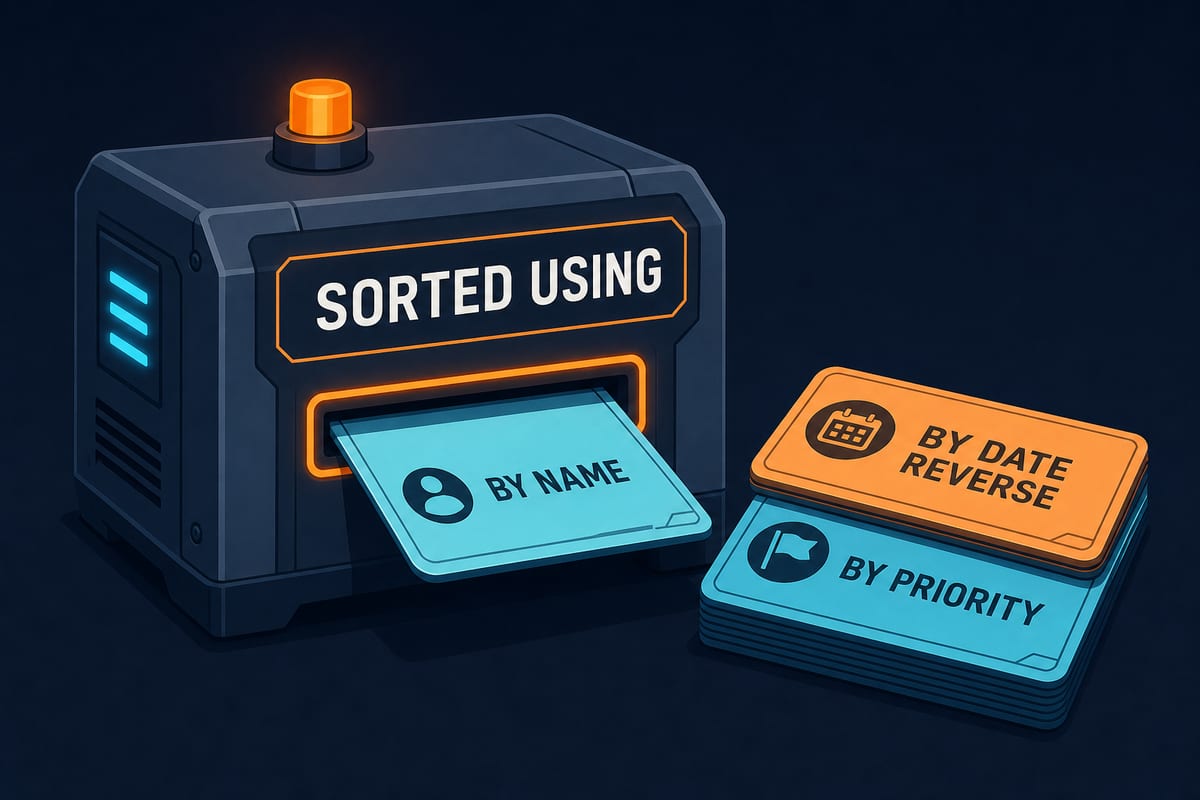
Externalizing sort criteria. When building a table-sorting UI, declare the criteria as an array of KeyPathComparator values instead of writing a sorting function for every column. For example, [KeyPathComparator(\.name), KeyPathComparator(\.date, order: .reverse)]. Change only the comparators based on the column selected by the user and pass them to items.sorted(using:); the sorting logic stays fixed in one line while the criteria move as data.
Form-binding and validation tables. Declare “this field corresponds to this User property” with a KeyPath, and field iteration, validation, and persistence become table-driven code. The logic does not grow as fields are added.
The foundation of SwiftUI and Observation. The id parameter of List(users, id: \.id) is a KeyPath, and the Observation framework also uses KeyPath to track “which properties were read.” KeyPath is the standard currency anywhere a framework needs to know “which property of your type.”
You can see the common pattern: keep the logic fixed and inject the property it applies to as a value. Just as generics make the type a parameter, KeyPath makes property selection a parameter. It is fair to call this a lightweight version of the Strategy pattern.
One caution is overuse. Generic APIs that mix \.self with multistep paths quickly become difficult to read. Following the Progressive Disclosure guideline, once complexity starts leaking into call sites, fall back to an ordinary closure or an explicit function.
Summary
- KeyPath is a type that turns a property access path into a value.
\User.nameisKeyPath<User, String>, and typos and type mismatches are caught at compile time. map(\.name)is the automatic conversion introduced by SE-0249. Use KeyPath for simple extraction and a closure when transformation is involved.- There are three layers: read-only KeyPath, WritableKeyPath for value types, and ReferenceWritableKeyPath for reference targets. A modifying function requires WritableKeyPath, embedding the contract in its signature.
- Its real value is parameterizing property selection. It is the standard tool wherever you need “one logic, swappable target property,” such as sort criteria, form binding, and id selection.
This concludes the eight-part intermediate series. Next comes the advanced series on Swift Concurrency. The first article will explain which callback problems async/await solved and how, along with the precise meaning of suspension.