
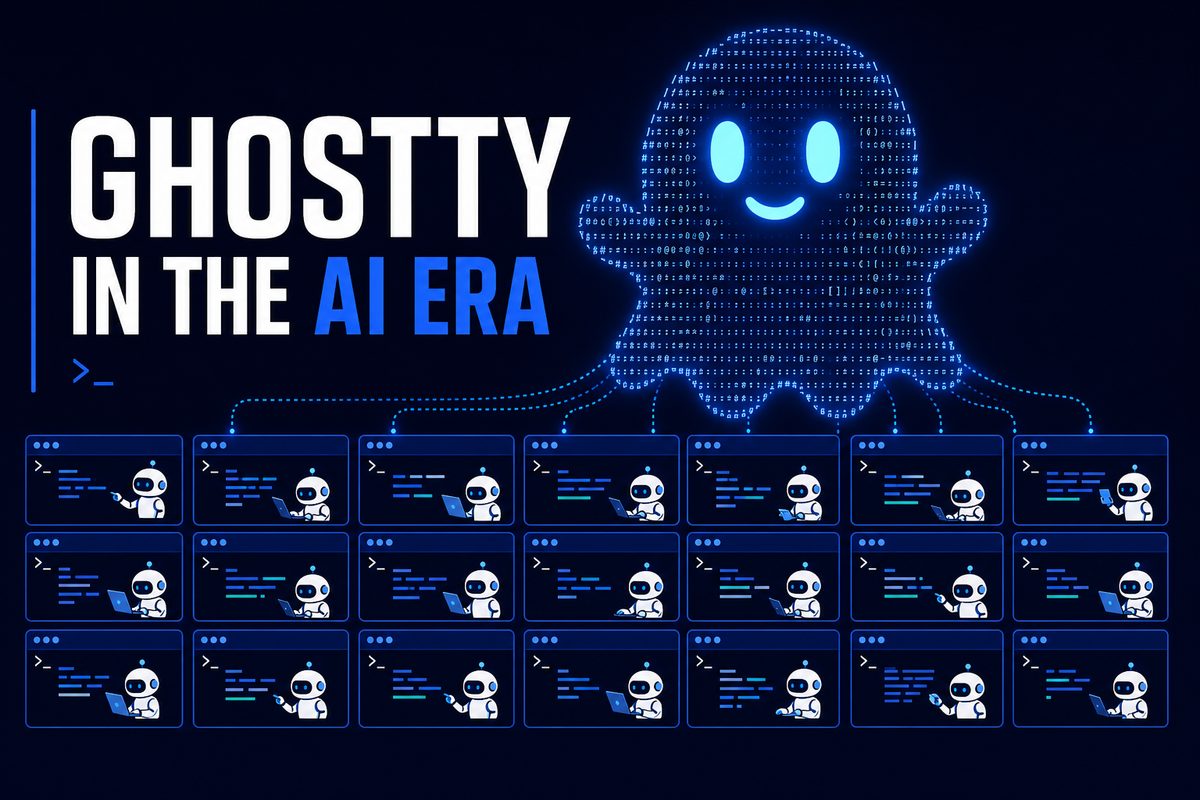
Why Ghostty Is Rising in the AI Era: cmux and Orca Herald a Terminal Renaissance
For a while, the terminal was a tool you used when available. As the IDE became the center of development, the terminal was relegated to a secondary window for checking build logs. But after 2025, everything changed. With AI coding agents such as Claude Code, Codex CLI, and Gemini CLI all released as terminal apps, the terminal returned to the heart of the development workflow.
Ghostty is the terminal attracting the most attention in this trend. Recently popular agent-operation tools such as cmux and Orca consistently use Ghostty as their technical foundation or quality benchmark. This article summarizes what makes Ghostty different, why it is gaining prominence in the AI era, and what the cmux and Orca cases each demonstrate.
Ghostty, the Terminal Created by HashiCorp’s Founder
Ghostty is an open-source terminal emulator developed by Mitchell Hashimoto, co-founder of HashiCorp, which created Terraform and Vagrant. Version 1.0 was released on December 1, 2024, and it is written in Zig.
The terminal emulator market was already saturated. With options ranging from iTerm2 and Alacritty to kitty and WezTerm, Ghostty found a clear opening: existing terminals each gave up one of three things.
- Fast (Alacritty) — but with minimal features
- Feature-rich (iTerm2) — but heavy
- Cross-platform (kitty, WezTerm) — but without a truly native OS experience
Ghostty was designed to deliver all three: “fast, feature-rich, and native.” It uses GPU-accelerated rendering for speed, while providing genuinely native UI through AppKit and SwiftUI on macOS and GTK4 on Linux. Tabs, splits, and shortcuts behave exactly as OS standards dictate, and the fact that it is useful immediately after installation without configuration fueled its early word of mouth.
Releases have also been steady. Version 1.2 in September 2025 added macOS Tahoe support and a command palette, while version 1.3 in March 2026 added the much-requested scrollback search and native scrollbars.
Why the Terminal, Specifically in the AI Era
There are practical reasons why companies building AI coding agents chose the terminal over a GUI (Graphical User Interface). A terminal app runs the same way on a local MacBook, an SSH-connected server, or a CI pipeline. It fits into any development environment, regardless of the editor. From an agent’s perspective, the terminal is the most universal execution environment.
But once agents moved into the terminal, the terminal’s role itself changed.
First, output volume exploded. Unlike the days when people typed commands and read the results, agents continuously stream code diffs, build logs, and tool-call histories. As streaming output increases, rendering performance determines perceived quality, and the advantages of GPU-accelerated terminals become apparent in real-world use.
Second, multiple sessions began running simultaneously. Since people can only wait while an agent works, running two or three agents in parallel naturally became the norm. The terminal evolved from a “window for entering one command” into “infrastructure for managing multiple agents.”
Third, apps layered on top of the terminal became necessary. Managing parallel agents requires features such as tabs, notifications, and status indicators—capabilities beyond the terminal emulator’s original scope. This created a new app category: “agent-management apps that contain a terminal.” Apps in this category want to use a proven engine instead of implementing terminal emulation themselves.
This is exactly where Ghostty’s real strategic advantage emerges.
libghostty, the terminal as a library
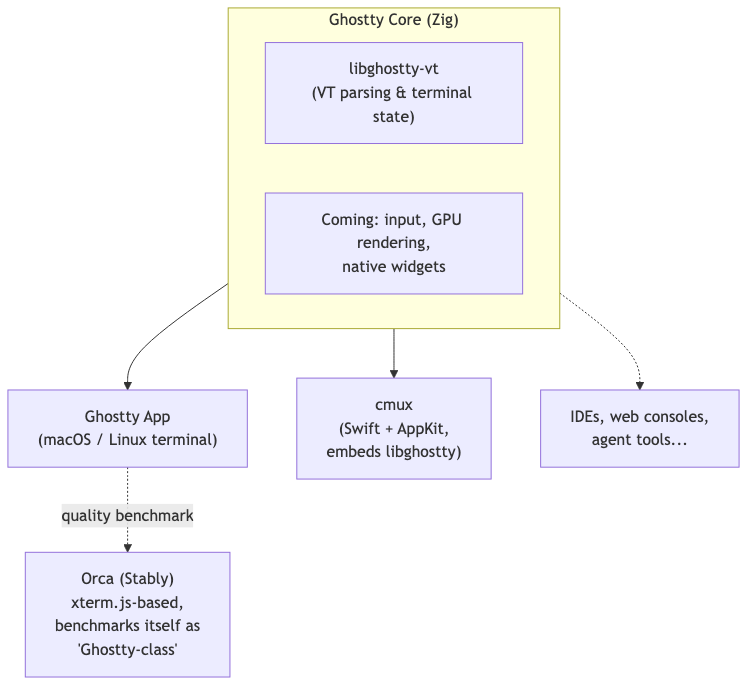
In his September 2025 post “Libghostty Is Coming,” Mitchell Hashimoto revealed Ghostty’s next step. The plan is to separate Ghostty’s core into an embeddable library called libghostty, allowing any app to embed proven terminal emulation. Just as an app that needs a web view can use WebKit instead of building a browser from scratch, an app that needs a terminal can use libghostty.
The first result is libghostty-vt. It is a library that interprets VT (Virtual Terminal) control sequences and manages terminal state. With no dependencies and a C API (Application Programming Interface), it can be used from any language. Terminal sequence interpretation is a domain where decades of tangled specifications have led IDEs and web consoles to implement subtly different behaviors; the goal is to share a single implementation proven in practice. Plans have also been announced to gradually turn input handling, GPU rendering, and platform-specific widgets into libraries.
This vision aligned perfectly with the AI-agent boom. Terminal emulation is essential for teams building agent-management apps, but too deep a domain to implement themselves. libghostty became the standard component that fills that gap.
cmux, the first major libghostty embedding case
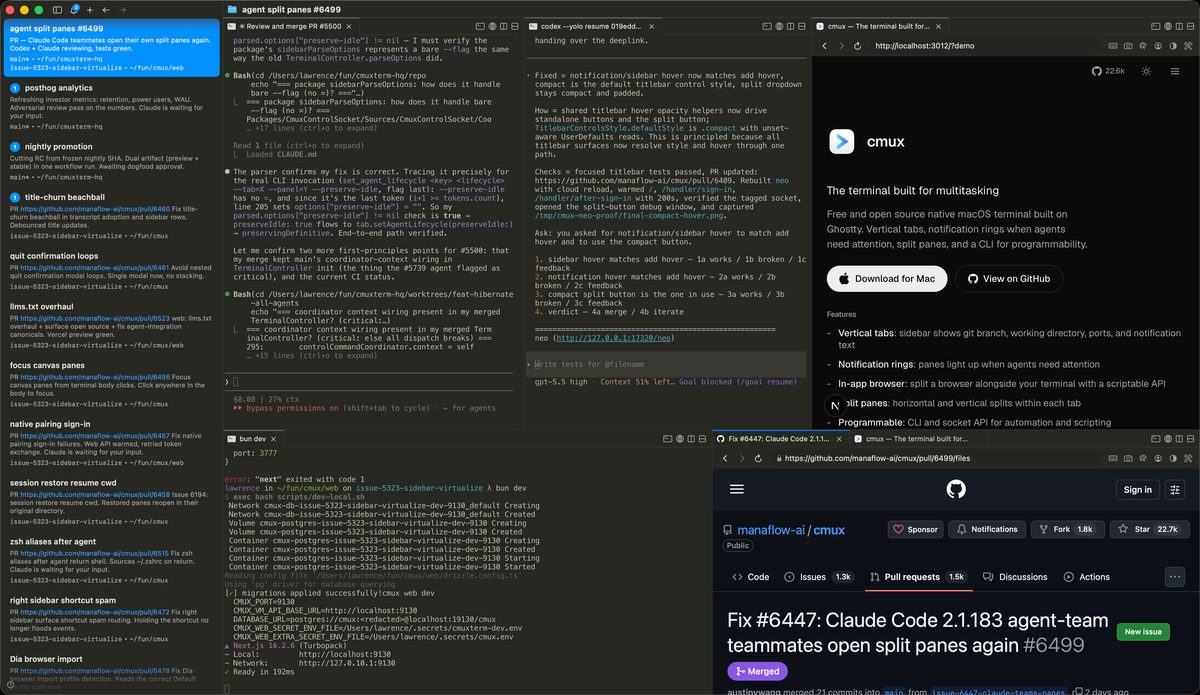
cmux is a macOS-only terminal app released by manaflow-ai that positions itself as “the terminal for AI coding agents.” It quickly attracted attention, reaching 25,000 GitHub stars.
Technically, the interesting point is that cmux is not a Ghostty fork. It is a native app written in Swift and AppKit that embeds libghostty as its rendering engine. The team describes this as “the same way an app uses WebKit in a web view.” It also reads existing Ghostty users’ settings files (~/.config/ghostty/config) as-is, carrying over their themes and fonts.
Everything built on top of that is for agent orchestration. Vertical tabs let you scan numerous agent sessions, and a blue border appears on a tab when its agent is waiting for input. The sidebar shows git branches, PR status, and open ports, while the CLI and socket API let you script everything from creating workspaces to sending keystrokes. By delegating the underlying terminal emulation to libghostty, the team could focus exclusively on orchestration features.
Orca: A case where “Ghostty-class” became the quality benchmark
Orca is an open-source ADE (Agent Development Environment) created by Stably. It runs agents in parallel by assigning each one an independent git worktree, and provides a terminal, diff review, and embedded browser in one app. With more than 28,000 GitHub stars, it is regarded alongside cmux as one of the leading products in this category.
Orca demonstrates a slightly different kind of influence. In its official introduction, Orca describes its terminal as “Ghostty-class terminals”. As of July 2026, its actual implementation is based on an xterm.js-family engine with WebGL rendering layered on top; it does not use libghostty. Even so, it uses Ghostty as the unit when describing its terminal’s quality. The fact that product copy is beginning to say “Ghostty-class” instead of “native-class” is itself a sign that a tool has become the de facto benchmark.
In summary, these two cases demonstrate Ghostty’s standing from different angles. cmux is a case of adopting libghostty as a component, while Orca is a case of citing Ghostty as a quality benchmark.
Could the terminal become the browser of the AI era?
The browser wars were decided not by browser apps, but by the engines inside them—WebKit and Blink. A similar pattern is now emerging in terminals. The killer workload of AI agents has brought terminals back to the center of development, a new app category is forming on top of them, and Ghostty is aiming to become the engine for that entire category through libghostty.
Of course, variables remain. libghostty is still at an early stage, with only the vt module released, and integrations like cmux will not be easy for everyone until the GPU rendering and widget layers are available. Even so, the direction seems clear. As the number of agents grows, so does the number of terminal sessions; as sessions multiply, the value of a proven terminal engine increases. If you have always viewed terminals as “identical black windows,” they are worth taking another look at now.