
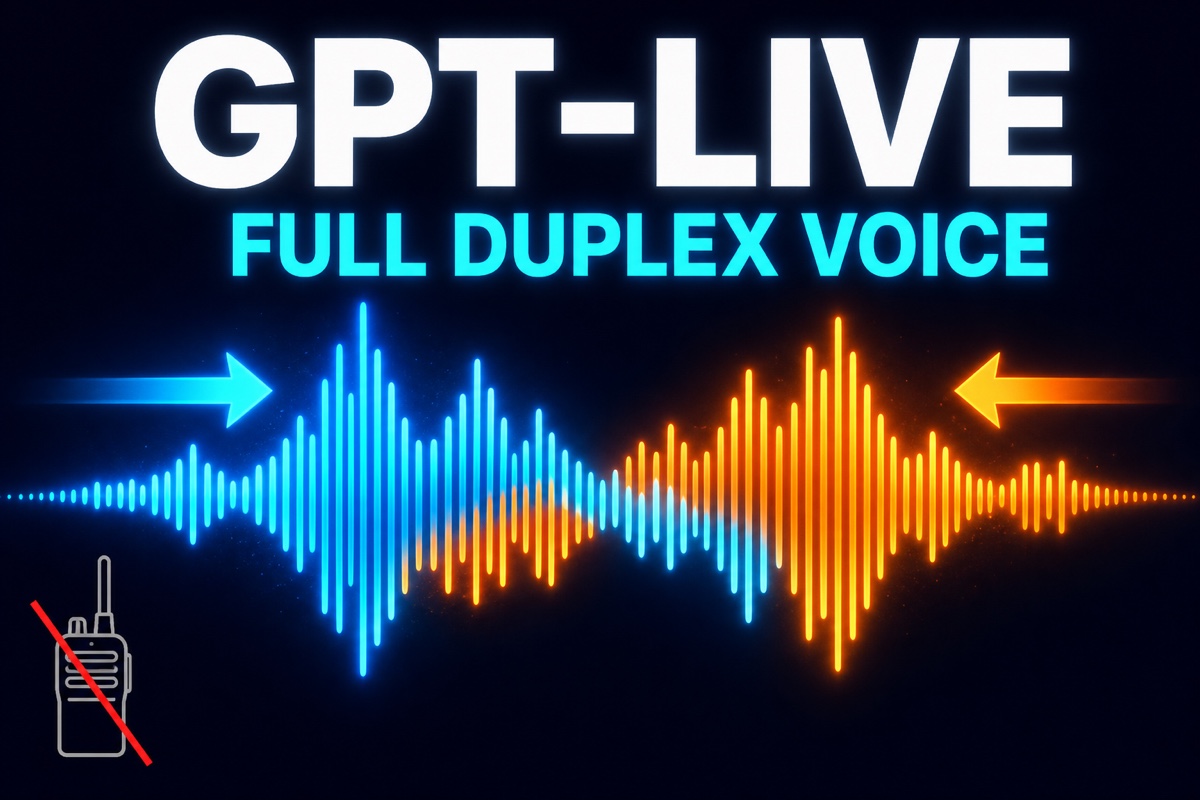
OpenAI has launched its new voice model, GPT-Live. If I had to pick one key sentence from the announcement, it would be this: “A full-duplex architecture that listens and speaks simultaneously.” No matter how fast previous voice AI became, it was still a walkie-talkie: one side had to finish speaking before the other could respond. GPT-Live turns that structure itself into a telephone. Here is a look at what changed and why it matters from an architectural perspective.
Let’s first take a quick look at how a new voice conversation begins.
▶ GPT-Live voice conversation start screen (official OpenAI)
From Cascaded to Turn-Based, and Then to Full Duplex
Voice AI architectures have gone through three stages.
Early ChatGPT voice conversations used a cascaded architecture. A speech recognition model converted speech to text, a language model generated a response, and a text-to-speech model converted it back into audio—a relay race between three models. Simply being able to converse with a frontier model by voice was groundbreaking, but information leaked each time it crossed a model boundary, making responses slow. The architecture also had a fundamental limitation: nuances in the speaker’s voice disappeared the moment they were converted into text.
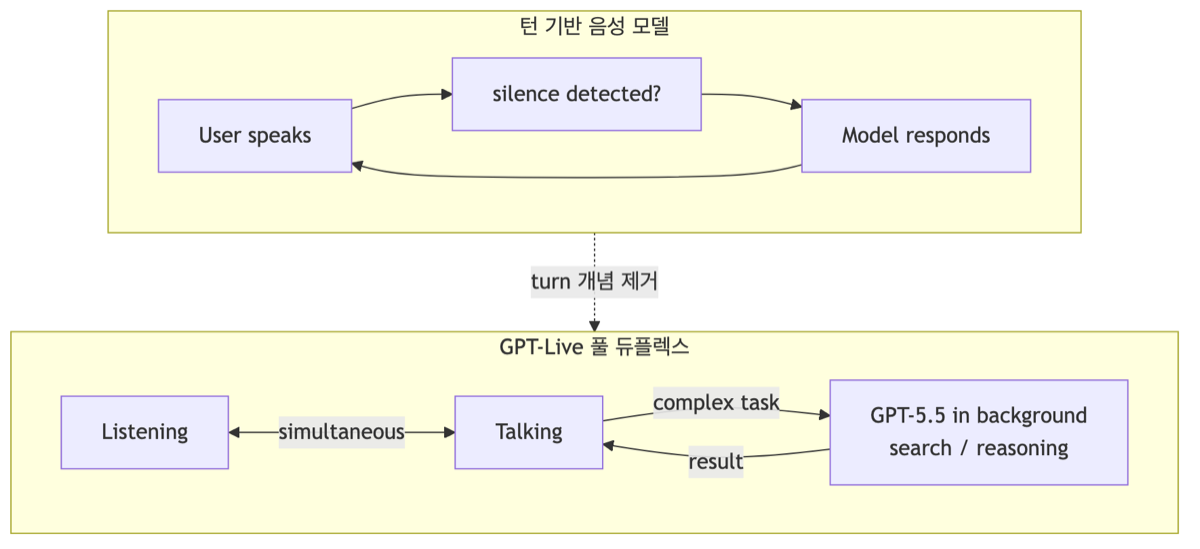
Turn-based models, represented by Advanced Voice Mode, combined all of this into a single model. Processing and generating speech directly reduced latency and made expression more natural. Yet conversations were still handled one turn at a time. The system waited for the user to finish speaking before responding, and the problem was that it identified “finished speaking” through silence. A brief pause to gather your thoughts could trigger an interruption, while background noise could be mistaken for the end of the conversation.
GPT-Live abandoned the concept of a turn itself. While generating a response, it continues processing the user’s input and makes several decisions per second: whether to speak, keep listening, pause briefly, interrupt, or use a tool. This architecture enables backchanneling—responding with “mm-hmm” or “yes” while the other person is speaking—as well as real-time interpretation. You can grasp the difference faster by hearing it than by reading about it. I’ll include two demo videos released by OpenAI.
▶ Natural conversation demo (official OpenAI)
▶ Simultaneous listening and speaking: real-time interpretation demo (official OpenAI)
The Second Design: Separating Conversation from Reasoning
The role separation is as noteworthy as the full-duplex design. GPT-Live handles seamless interaction, while questions requiring search or deep reasoning are handed off to a frontier model in the background. At launch, GPT-5.5 fills that role, with OpenAI stating that it will be replaced when a new frontier model becomes available.
This design is clever for two reasons. First is the user experience. GPT-Live keeps the conversation going while heavy work runs in the background. Instead of silence while waiting for search results, the conversational flow is preserved. The second is the upgrade path. Because the conversation and reasoning roles are separate, you can swap only the back-end model to improve intelligence while keeping the voice experience unchanged. It is the same idea as separating the orchestrator from workers in an agent system.
The performance numbers support this design as well. According to OpenAI, GPT-Live-1 outperformed advanced voice mode on GPQA, which evaluates expert-level scientific reasoning; BrowseComp, which evaluates agentic web search; and τ³-Voice Telecom, which evaluates multi-turn voice tasks in telecommunications support environments. In 5–10-minute real-world comparison evaluations, it also received higher preference scores for turn-taking, interruptions, and conversational flow. The demo below shows how background delegation works in practice.
▶ Smarter Answers: Background Reasoning Demo (Official OpenAI)
What You Can Use—and What Is Not Available Yet
Here is how it is being offered. GPT-Live-1 and GPT-Live-1 mini are being rolled out sequentially to users worldwide on iOS, Android, and ChatGPT.com. Go, Plus, and Pro plans use GPT-Live-1 by default, while Free uses mini. You can also choose the reasoning level: select Instant for fast responses, or Medium or High for deeper answers, which run GPT-5.5 Thinking in the background.
During conversations, topics such as weather, stocks, and sports are shown in visual cards, while search, memory, images, and file uploads remain available directly within voice conversations. Its ability to focus on the user’s voice amid background noise has also been improved. Official demos of both features are available.
▶ Visual Cards During Conversations Demo (Official OpenAI)
▶ Conversation demo amid background noise (official OpenAI)
The safety mechanisms were redesigned for voice as well. Because voice conversations happen in real time, safeguards can operate while a response is being delivered, and the conversation can be ended when the risk is high. For conversations involving self-harm, crisis hotlines are provided. Parents can configure whether teen accounts may use voice conversations, and may be notified in high-risk situations. It is also clearly stated that only nine predefined voices are available, to prevent imitation of real people’s voices.
Some capabilities are still unavailable. The developer API is “coming soon,” and currently only supports signing up for launch notifications. Voice conversations used together with video and screen sharing are also absent at launch, so you must use the existing voice mode if you need those features. Language optimization focuses on major languages, and the company has stated that intonation may sound unnatural in some languages.

Summary
- GPT-Live is a full-duplex voice model that listens and speaks simultaneously. The awkwardness of the previous approach, which used silence to determine turns, has disappeared at the architectural level.
- GPT-Live handles conversation, while background GPT-5.5 handles search and reasoning. This separation makes it possible to keep improving only the intelligence behind the scenes while preserving the conversational experience.
- The rollout in ChatGPT starts sequentially from now, but the API is not available yet. Developers preparing a voice interface should consider designing around this architecture instead of a cascaded pipeline.
They say 150 million people talk with ChatGPT by voice every week. As voice shifts from an auxiliary input to the default interface, the disappearance of turns may prove to be a bigger inflection point than expected.