
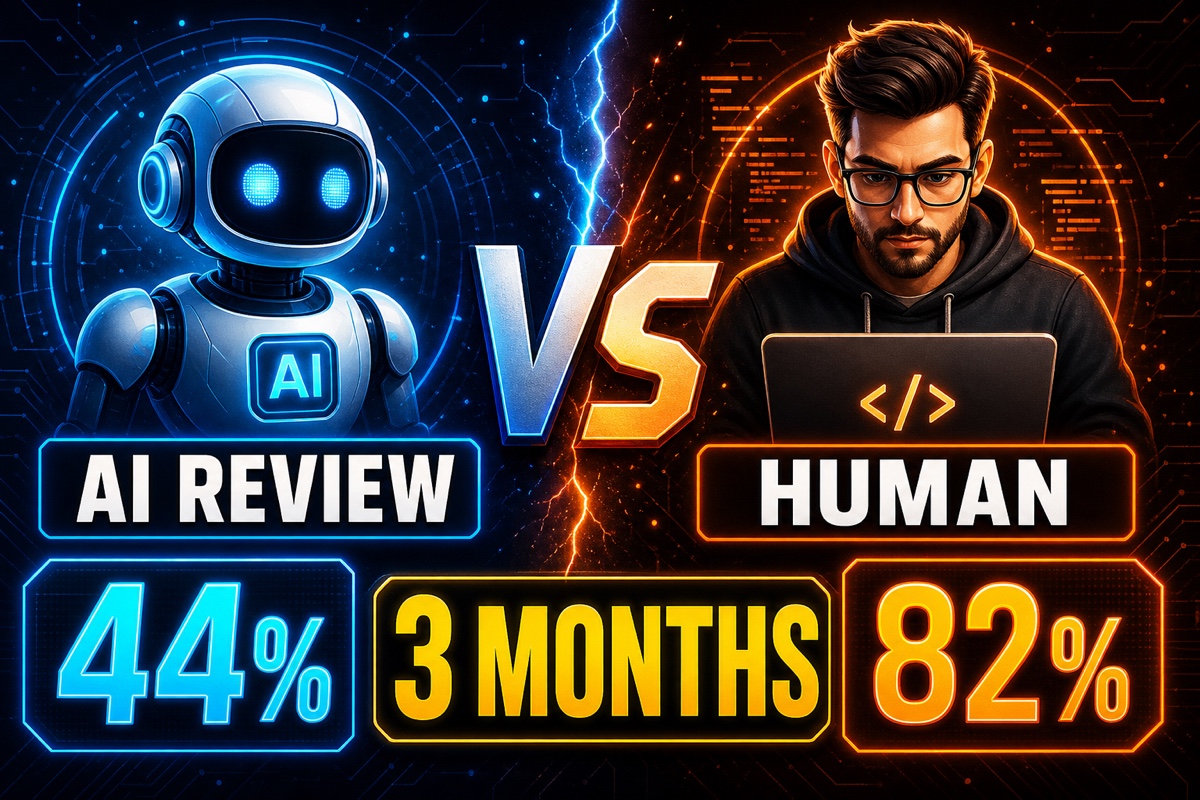
It has been three months since we introduced an AI code review tool to the team.
“If we add this, won’t we be able to skip human review?” We started half hopeful and half skeptical.
To cut to the chase, AI code review couldn’t replace human reviewers, but it became a reliable first-pass filter that took half the review work off our hands.
AI caught the minor mistakes that are easy to miss, while design and context still required human judgment.
Today, I’ve honestly summarized what it was like to use it in practice for three months.
Here’s What Happened After Three Months of AI Code Review
We set it up so that AI automatically comments whenever a PR (Pull Request) is opened.
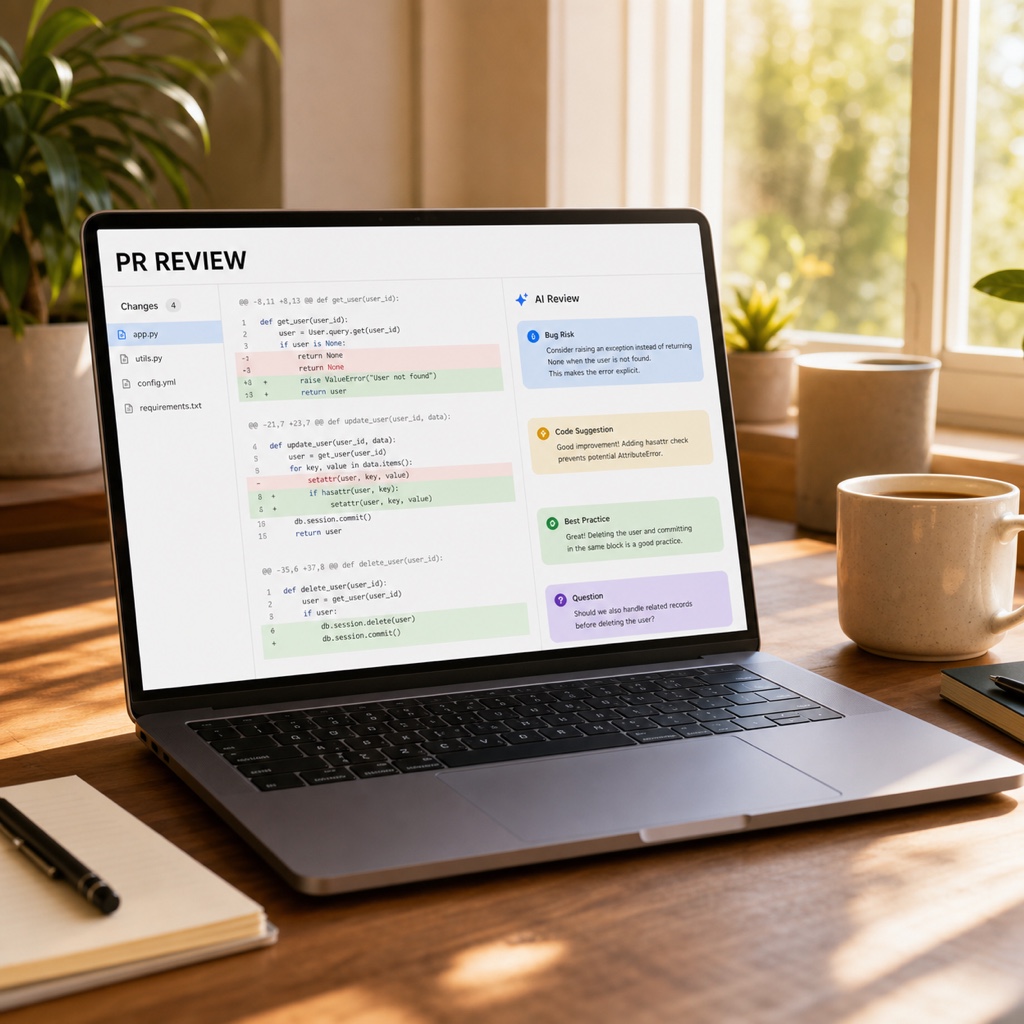
Honestly, I was impressed during the first week.
It caught things a person might miss after staring at code until their eyes hurt.
- Missing null checks
- Unused variables and duplicate logic
- Typos and incorrect variable names
- Missing exception handling
I was especially grateful when it pinpointed mistakes I missed in PRs I rushed out late at night.
Review wait times also dropped sharply. PRs that used to sit for half a day waiting for a human reviewer could move straight to fixes thanks to AI’s first-pass comments.
Well-built AI code review is less a “reviewer” than a sieve that filters code once before review.
How Many False Positives Does AI Code Review Produce?
This is probably what you’re most curious about. Honestly, there are more incorrect and questionable findings than expected.
Independent benchmarks as of 2026 indicate that even top tools get one out of every 12–20 AI comments wrong. False positives remain the number-one complaint about every tool.
My experience was similar.
It sometimes flagged intentional code as a bug or asked us to handle an exception that was already handled elsewhere.
The tools also differed considerably in their tendencies. For reference, here’s a summary.
| Tool | Tendency | Reference figure (as of 2026) |
|---|---|---|
| CodeRabbit | Accuracy first, few false alarms | Bug detection rate: about 44% |
| Greptile | Understands the whole codebase context and flags many issues | Bug detection rate: about 82%, but 30–50% requires manual verification |
| GitHub Copilot | Solid overall, but many findings are at linter level | 31 of 47 suggestions could also be caught by ESLint |
Tools that flag more issues leave more to filter; tools that flag fewer issues miss more. That was the trade-off.
In the end, the key wasn’t “how much does it catch?” but “does it catch useful things?”
So, Can It Replace Human Reviewers?
My conclusion after three months is clear.
It’s not replacement; it’s division of labor.
The areas where AI excels and where people excel were clearly different.
AI is particularly strong at the following:
- Syntax, style, and convention checks
- Finding repetitive, mechanical mistakes
- Immediate response, 24/7
Conversely, there were clear areas only people could handle.
- Judging the design intent behind “why this feature was built this way”
- Incorporating business context and team history
- Deciding priorities, such as “let’s accept this for now”
For example, AI is good at judging whether a single line of code is correct.
But decisions like “this structure will cause problems when we extend it three months from now” still belonged to people.
As a simple example, AI catches obvious mistakes like these well.
// AIA pattern it flags immediately: user nilwhen it fails
func getName(user: User?) -> String {
    return user!.name  // user nilmeans a forced-unwrapping crash
}

// It suggests fixing it this way
func getName(user: User?) -> String {
    return user?.name ?? "Unknown"
}
On the other hand, a person had to decide whether the function itself belonged in that location.
Practical Tips for Using AI Code Review (Q&A)
I’ve turned what I learned from using it into a Q&A.
Q. Can we reduce review staffing after adopting it?
No. It reduces human review time; it isn’t a tool for eliminating people. Instead, people can focus on more important design reviews.
Q. If there are many false positives, doesn’t it get in the way?
That’s right. So it’s important to configure rules and ignore handling carefully at the start. Some tools, such as CodeRabbit, learn and reduce false positives over time.
Q. Which teams benefit most?
It’s highly effective for teams short on reviewers or bottlenecked by a surge of PRs. Used as a first-pass filter, it greatly reduces the burden on human reviewers.
After using it for three months, I don’t want to turn off AI code review.
It isn’t perfect, but alongside human reviewers, it clearly improves both the team’s code quality and speed.
If you’re considering adoption, I recommend starting lightly with the mindset of a “first-pass filter,” not a “replacement.”