
![Cover image for [Swift Basics #4] Using guard to flatten the pyramid of doom](/assets/images/posts/eb18b3e1-ed72-4816-890a-2865806e1441/1.jpg)
One comment often heard in code reviews is, “Let’s change this to guard.” The code behaves identically with if, so why insist on changing it? It may sound like a matter of taste, but guard is syntax Swift designed to encourage a particular coding style: early exit and a left-aligned happy path.
This is part 4 of the Swift Basics series. In the optionals article, I briefly introduced guard let as an unwrapping tool. This time, we will examine guard itself: how it differs from if, what the compiler guarantees, and when if—not guard—is the right choice.
If you want to revisit the state of having no value, read What Swift optionals really are and how to unwrap them first.
The problem — the pyramid of doom
First, let’s look at code from before guard existed. A sign-up function has plenty to validate: whether the input is nil, whether its format is valid, and whether the terms were accepted.
func signUp(email: String?, password: String?, agreed: Bool) {
    if let email = email {
        if isValidEmail(email) {
            if let password = password {
                if password.count >= 8 {
                    if agreed {
                        // The thing we really wanted to do
                        createAccount(email, password)
                    } else {
                        showError("Terms acceptance is required")
                    }
                } else {
                    showError("The password is too short")
                }
            } else {
                showError("Enter a password")
            }
        } else {
            showError("This is not a valid email format")
        }
    } else {
        showError("Enter an email address")
    }
}
The indentation is five levels deep. This shape is called the pyramid of doom, and it carries a real reading cost beyond looking ugly. The function’s main work, createAccount, is buried at the deepest level, while each check’s failure handling, else, is visually far from its condition. To answer “What happens if the password is too short?” you must match braces by eye while scrolling.
guard’s answer — failures first, main work on the flat path
Rewriting the same function with guard looks like this.
func signUp(email: String?, password: String?, agreed: Bool) {
    guard let email, isValidEmail(email) else {
        return showError("Check the email address")
    }
    guard let password, password.count >= 8 else {
        return showError("Check the password (8 characters or more)")
    }
    guard agreed else {
        return showError("Terms acceptance is required")
    }

    createAccount(email, password)
}
The structure is inverted. Each condition is attached to its failure handling as one unit, while the main work—after passing every checkpoint—sits flat at the bottom of the function. The reader’s eye only needs to flow downward once. The function’s logical structure, “preconditions, then main work,” now matches its visual structure.
This benefit is often called left-aligning the happy path. Normal flow stays at indentation level zero, while only exceptional cases enter blocks. Even as a function grows, the rule remains consistent: follow the left edge to see the normal scenario.

The real difference from if — two compiler-enforced guarantees
You may be about to ask, “Can’t if also perform an early exit?” Yes. Write it like if email == nil { return }. But guard is more than an inverted if: it provides two guarantees enforced by the compiler.
First, the else block must leave the scope. Inside guard’s else, the current scope must be exited with return, throw, continue, break, or fatalError; otherwise compilation fails. An if-based check can forget to return after validating a condition, but guard catches that mistake at compile time. “If execution passed this point, the condition is true” becomes a guarantee, not a convention.
Second, the unwrapped value remains available throughout the code below guard. An if let binding is valid only inside the if block, whereas a guard let binding can be used throughout the remaining scope after guard. The value that passed the checkpoint stays available to the end of the function, avoiding the awkward separation between unwrapping and use.
Together, these guarantees make guard serve as documentation. A group of guard statements at the start of a function declares its list of preconditions. Contracts that do not fit in the signature become readable from the first lines of the body.
When if—not guard—is the right choice
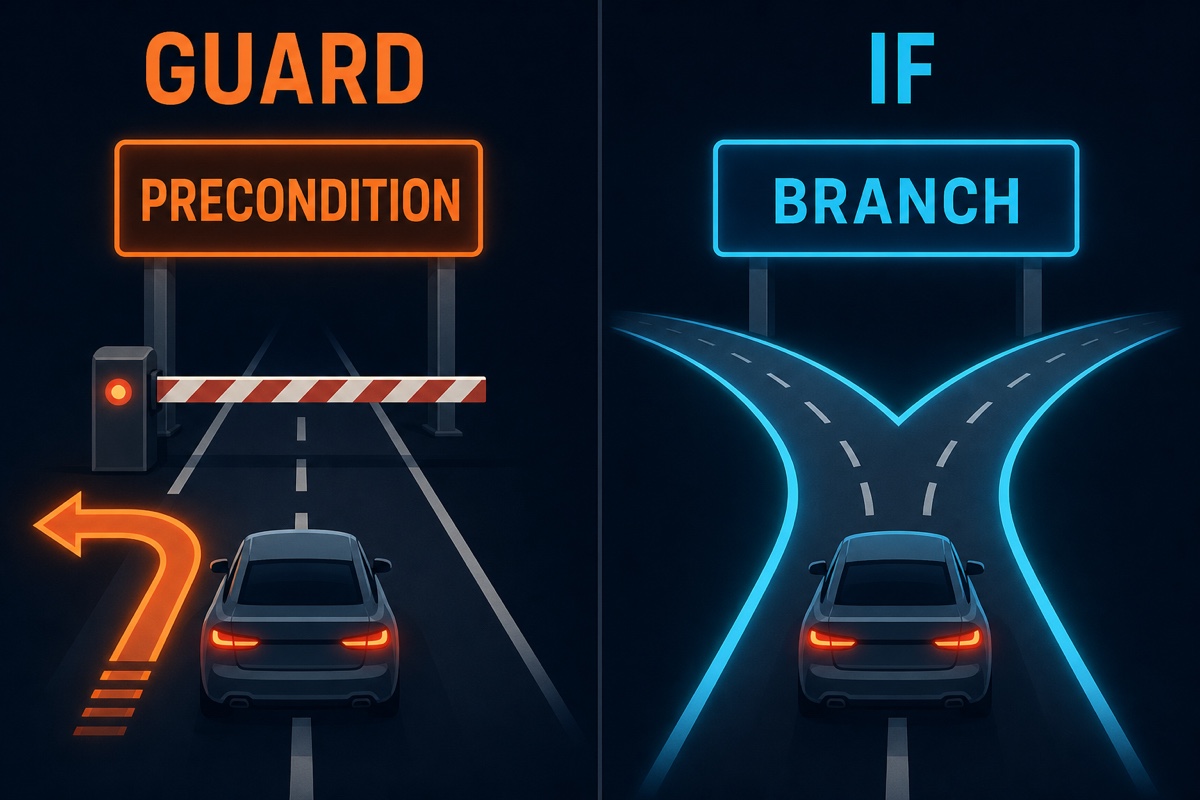
Should we replace every if with guard? No. The distinction is clear: use guard for a precondition meaning “we cannot continue without this,” and if for branching meaning “do this in one case and that in the other.”
// ifThe right place for if — both paths are normal flow
if user.isPremium {
    showPremiumBadge()
} else {
    showUpgradeButton()
}
Not being premium is not a failure. If both branches continue as normal scenarios, use if. Writing this as guard would incorrectly suggest that non-premium users are abnormal.
Conversely, if failing a check ends the function, guard is appropriate even when there is only one check. The syntax choice communicates meaning. Readers expect guard to signal a precondition and if to signal a branch, so readability comes from meeting those expectations.
One antipattern is worth noting: filling guard’s else block with logic. Once you start attempting recovery, changing state, or performing lengthy work there, guard’s promise that failure ends quickly is broken. If else grows beyond three lines, treat it as a signal to revisit the design. Failure handling that complex is a separate branch or something to throw to the caller.
guard in loops and asynchronous code
guard is also used outside functions. Inside loops, it pairs with continue to express “skip this item.”
for item in items {
    guard item.isValid else { continue }
    guard let url = item.downloadURL else { continue }
    process(url)
}
When there are several filtering conditions, guard keeps the for body flat. For simple conditions, for item in items where item.isValid or compactMap may be more concise. Use where when one clause is enough; use guard when unwrapping and multiple stages are involved.
In asynchronous code, combining [weak self]—familiar from closures—is practically an idiom.
fetchData { [weak self] data in
    guard let self else { return }
    self.update(with: data)
}
The precondition “do nothing if self has already been deallocated” is handled on the first line, and the remaining code proceeds on a flat path where self is available. This is where guard’s early-exit philosophy meets memory management.
Results confirmed by direct execution
In Apple Swift 6.3.3, I created a function accepting String? input, rejected nil in guard’s else, and used the bound string on the next line when a value was present.
guard=rejected,accepted:devpawThis output matches my code-review standard for recommending guard. If failed input ends the current path and only validated values continue through the main body, use guard. If both true and false are normal business flows, keep if instead of changing it merely for a flatter appearance.
Summary
- guard supports early exit at the language level, turning the pyramid of doom into a structure of listed preconditions followed by flat main work.
- The difference from if is compiler enforcement: else must exit the scope, and bindings remain valid throughout the later scope.
- Rule of thumb: use guard for preconditions that block progress on failure, and if for branches where both paths are normal. The syntax itself communicates meaning.
- A long else block signals that guard is being misused. Handle complex failure logic with branching or by throwing an error.
The final sentence mentioned “throwing an error.” That is the subject of the next article: throws, the three forms of do-catch, try?, and try!, plus Result—the complete map of Swift error handling.
Recommended reading
- Swift Decorator Pattern: Layering Features Without Inheritance (Examples and Practical Guide)
- [Swift Basics #5] Swift Error Handling: When to Use throws, try?, try!, and Result
- [Swift Basics #6] Why Can’t Swift Strings Use text[0]? A Complete Guide to Grapheme Clusters
Sources and verification
- The Swift Programming Language: Control FlowSwift.org · Official documentation · Checked August 26, 2026Supports: guard early exit, optional-binding scope, and readability
- The Swift Programming Language: StatementsSwift.org · Standard or specification · Checked August 26, 2026Supports: The rule that guard else must transfer control using return, break, continue, throw, or Never