
Naver Blog AI Automation: How Far Is Possible, and Where Does It Violate the Rules?
These days, many more people are writing blog posts with AI tools such as ChatGPT and Claude. If you take it a step further, you may even start wondering, “Why not automate everything from generating the post to publishing it?”
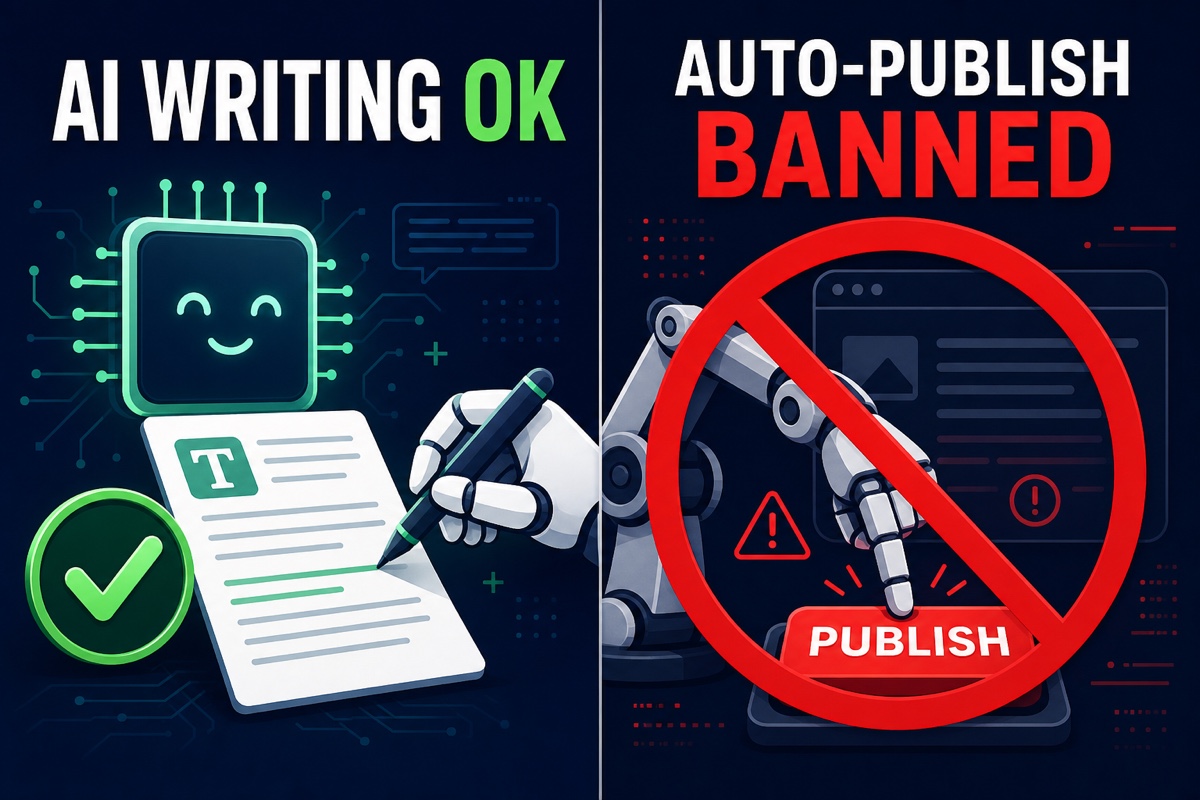
Let me get straight to the point. Anyone can use AI to create articles, and doing so does not violate policy. However, “full automation” that uses a program to automate publication is a violation of Naver’s terms of use.
I worked as a developer at Naver. Drawing on that experience, this article explains exactly where the boundary lies and summarizes practical ways to make the most of AI while staying within policy.
Writing with AI itself is not prohibited
Let me clear up one misconception first. You often hear that “Naver detects and blocks AI-generated articles,” but that is not the standard Naver has officially stated.
Naver Search evaluates document quality and source credibility using logic such as C-Rank and D.I.A. The direction is the same in recent search-logic updates. It does not focus on whether AI or a person wrote the article. Instead, it looks at the following.
- Does it actually answer the questions readers have?
- Is it original content rather than a patchwork of other articles?
- Does the author have expertise built through consistently covering the topic?
- Are there genuine reader responses such as time spent, likes, and comments?
In other words, an article drafted with AI and refined with your own experience and information can rank well in search. Conversely, even an article written by a person may be judged low quality if it is filled with promotional copy or merely copies content seen elsewhere.
AI is only a tool; Naver evaluates the quality of the result.
Then why is “full automation” not allowed?
The problem is the publication step.
Naver’s terms of use explicitly prohibit using the service through automated means. Quoting the relevant language from the official terms:
“Without Naver’s prior permission, you must not attempt to join or join Naver services as a member, attempt to log in or log in to Naver services, post content on Naver services using automated means such as macro programs, robots (bots), spiders, or scrapers, or use or attempt to use Naver services in a manner that does not align with the purpose of providing services intended for actual use by users (people) …”
— Naver Terms of Use (policy.naver.com)
“Posting content” is explicitly included. Automated publishing falls exactly within that clause. The terms also prohibit attempts to disable anti-abuse measures themselves, such as connecting through changing IP addresses or bypassing Captcha.****
Naver Blog has no official publication API. The blog-posting API that once existed has already been discontinued. So full automation ultimately requires methods such as these.
- Automatically logging in and registering posts with a browser-automation tool such as Selenium
- Operating the editor with a macro program
- Calling internal APIs through unofficial routes
All three qualify as “using the service through automated means,” which the terms prohibit. If detected, they can lead to post deletion, reduced search visibility, and, in serious cases, account restrictions. Automated publishing is particularly easy to detect because it leaves publication patterns such as exactly identical times and mechanical intervals.
This is also what I felt while working at Naver. Naver is extremely sensitive to policy and abuse issues internally. Filtering abnormal usage patterns is considered from the design stage of a service, and the company continues to invest in related detection systems. It is more accurate to assume that even patterns you think are too subtle to detect will eventually appear in the data if they accumulate over time.

The table makes it clear.
| Stage | AI and automation use | Policy assessment |
|---|---|---|
| Topic selection and research | Allowed | No issue |
| Draft generation and sentence refinement | Allowed | No issue (evaluated only on quality) |
| Image generation | Allowed | No issue |
| Login and publication | Automation prohibited | Terms violation |
The age of AI coding calls for extra caution
There is a reason to bring this up now.
In the past, you needed development knowledge to build an automated publishing program. Now, if you ask ChatGPT or Claude, “Write Python code to automatically upload posts to Naver Blog,” even non-developers can have a Selenium macro in hand within minutes. Such automated publishing scripts and paid programs are actively shared in communities and on social media.
The problem is that an AI that generates code does not also verify platform policies. “Can be built” and “may be used” are completely different questions, but as the barrier to creation has disappeared, more people simply run code without checking the rules. The fact that code works does not mean the action is permitted. Checking a platform’s terms of use and operating policies before using a tool is no longer just a developer skill; it has become basic knowledge for everyone who uses automation tools.
A practical workflow that stays within policy
So how far should automation go? The answer is a “automate generation, publish manually” workflow.
- Have AI select keywords and conduct research. Analyzing search intent and structuring an outline are areas where AI performs well.
- Generate a draft with AI. Do not use it unchanged; you must fact-check it and add your own experiences and examples. Without this step, it will fall behind in quality evaluations.
- Have a person review and refine it. This is where you catch incorrect information, awkward sentences, and duplicate phrasing.
- Publish it yourself. Paste the finished article into the Naver Blog app or editor, then let a person decide the image placement and publication time.
A few minutes per article is enough for publication. In effect, AI handles 80–90% of the entire task, while a person handles only the final 10%. That 10% is the safeguard that protects both policy compliance and writing quality.
Conclusion
To recap the boundary of AI automation for Naver Blog:
- Creating articles with AI: Allowed. Naver evaluates the quality and credibility of the article, not the writing tool.
- Publishing automatically with a program: Not allowed. Posting through macros or automated means is explicitly prohibited by the terms of use, and doing so risks account restrictions.
Thanks to AI, the barrier to operating a blog has clearly fallen, and we are now in an era where even people who cannot code can build automation tools. Just remember that pushing that convenience through the publication stage becomes a policy violation, and that mass-produced articles without review will ultimately be filtered out in quality evaluations.
Use tools as much as you like, but let a person press the final button — that is how to keep using AI on Naver Blog for the long term.
Reference materials (official Naver documents)
- Naver Terms of Use — Clause prohibiting login and posting through automated means
- Naver Content Operation Policy
- Naver Search Spam Documentation