
![Cover image for [AI User Guide #1] ChatGPT is not a search engine: How AI generates answers](/assets/images/posts/2749fa60-515f-449b-8e14-21906ac32b10/ai-not-search-engine-1.jpg)
When you ask ChatGPT something and receive an answer, it is easy to assume that it found a stored correct answer and showed it to you—like finding a document after entering a query in Naver or Google. But AI does not work that way. This misunderstanding leads to confusing experiences such as “AI lied” or “AI keeps changing its answer.” In this first installment, we clear up this misconception first.
Search engines find; AI creates
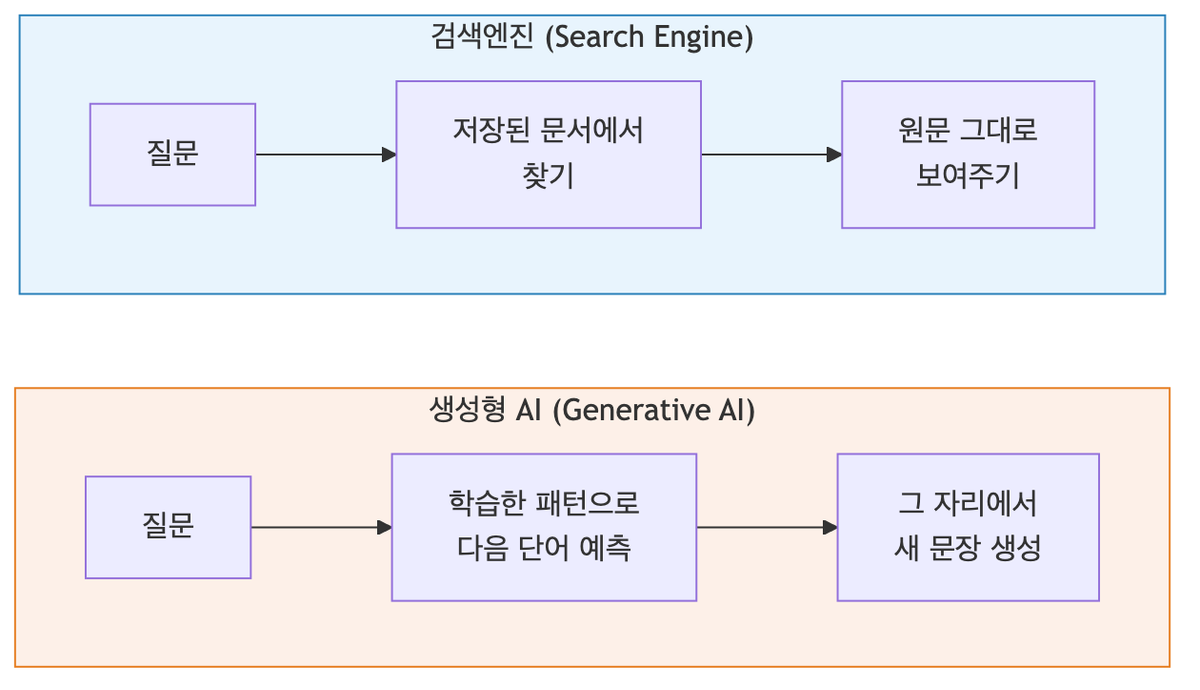
The difference between a search engine and AI is the difference between a librarian and a storyteller.
A search engine is a librarian. Ask for “restaurants in Jeju,” and it finds relevant documents on the shelves and hands them over as they are. It does not alter their content or invent documents that do not exist. These days, an AI summary often appears at the top of search results, but that part was written by a storyteller, not the librarian. Just remember that distinction.
AI systems such as ChatGPT are closer to storytellers. When they receive a question, they do not fetch a document from somewhere; they create a new sentence on the spot. The answer you receive is text that was not stored anywhere in the world. It was generated right then. That is why these systems are called generative AI.
So what do they base their answers on? This is where the key principle comes in.
One principle: predicting the next word
ChatGPT is built on a technology called an LLM (Large Language Model). The name sounds grand, but it does one thing: predict the next word that naturally follows the text so far.
Think of your smartphone keyboard’s autocomplete. Type “The weather today is” and it may suggest “nice.” An LLM scales that autocomplete far beyond imagination. By reading trillions of words from books, articles, and web pages, it learned patterns such as “this kind of phrase follows this kind of text.” As a result, it can continue not just a word or two, but an entire report.
That is how AI generates an answer: it receives your question, chooses the most plausible next word, then chooses another next word using the text including the first one. It repeats this dozens of times per second to complete the sentence.
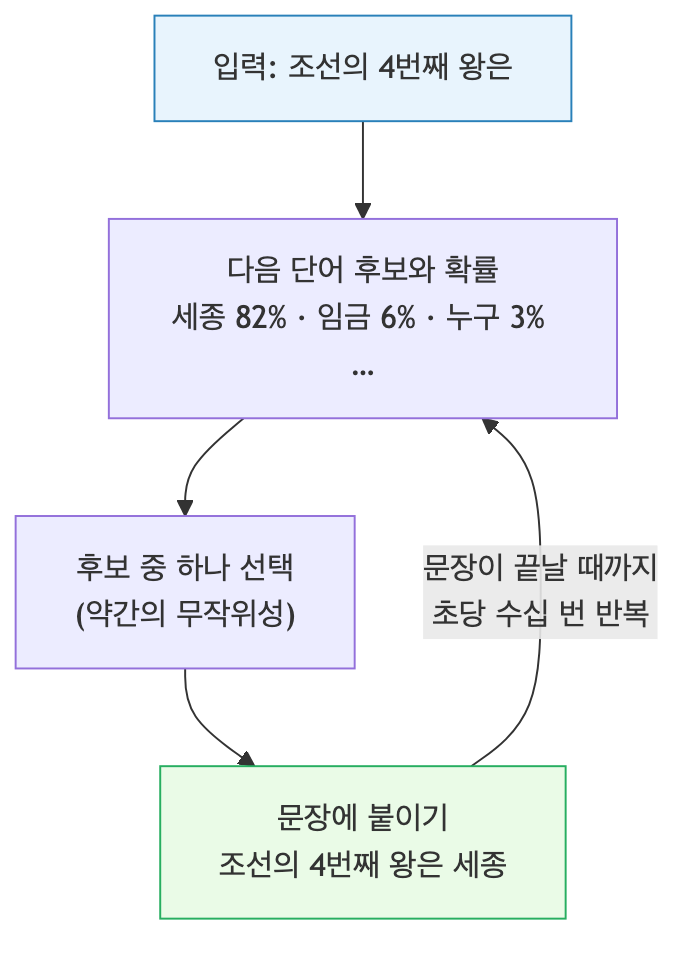
How can “plausible words” look intelligent?
You may wonder, “Is predicting the next word really all it does? Then how can it translate and summarize?”
The secret is scale. To predict the next word well, a model ultimately needs knowledge of the world. Predicting what follows “The fourth king of Joseon was” requires history; continuing “The bug in this code is” requires programming. While learning from vast amounts of text, knowledge and reasoning patterns were compressed into the model.
However, this knowledge is stored differently from a search engine’s. Documents are not kept intact; their patterns are embedded in hundreds of billions of numbers called parameters. It is similar to human memory. We cannot retrieve every character of a book we read last year, but we can discuss its contents. AI knowledge is therefore closer to “it was roughly about this” than to an exact quotation from the original.
Why the same question gets a different answer each time
When choosing the next word, AI does not always select the top candidate. It adds a small amount of randomness and chooses among high-probability candidates. Always selecting the top word would make answers mechanical and predictable, so the system deliberately introduces variation.
That is why asking the same question twice can produce different answers. It is not a malfunction; it is by design. If you think of AI as a search engine, you ask, “Why did the answer change?” If you think of it as a sentence generator, it makes perfect sense.
This property can be an advantage depending on how you use it. If you do not like an answer, you can generate again to get another version, and it is especially useful when you need diverse options, such as in an ideation session.
Why you should not ask for the latest news—and the exception
An LLM’s knowledge stops at the point when training is complete. This is called the knowledge cutoff. Events that happen afterward are not in the model. In principle, it cannot know yesterday’s news, today’s exchange rate, or movies opening this week.
Modern services supplement this limitation with web search. When a question requires current information, the AI searches first and then generates an answer based on the documents it found. It is like a storyteller who receives material from a librarian. Although many services search automatically, when asking about current information it is best to check that the answer actually includes source links. If you want to be sure, add, “Find it on the web and tell me.” This usage is covered in detail in Part 4.
Summary
- AI does not find a stored correct answer; it generates a sentence on the spot.
- Its principle is next-word prediction, and extensive training makes that prediction work like knowledge.
- Different answers to the same question are a design choice, not a malfunction.
- Knowledge stops at the training point, while web search supplements current information.
But this principle has a dark side. If AI’s goal is not to “state the correct answer” but to “create a plausible sentence,” it can produce statements that sound plausible yet are completely wrong. And it does—very confidently. In the next installment, we cover how to identify and handle AI-generated lies, known as hallucinations.