
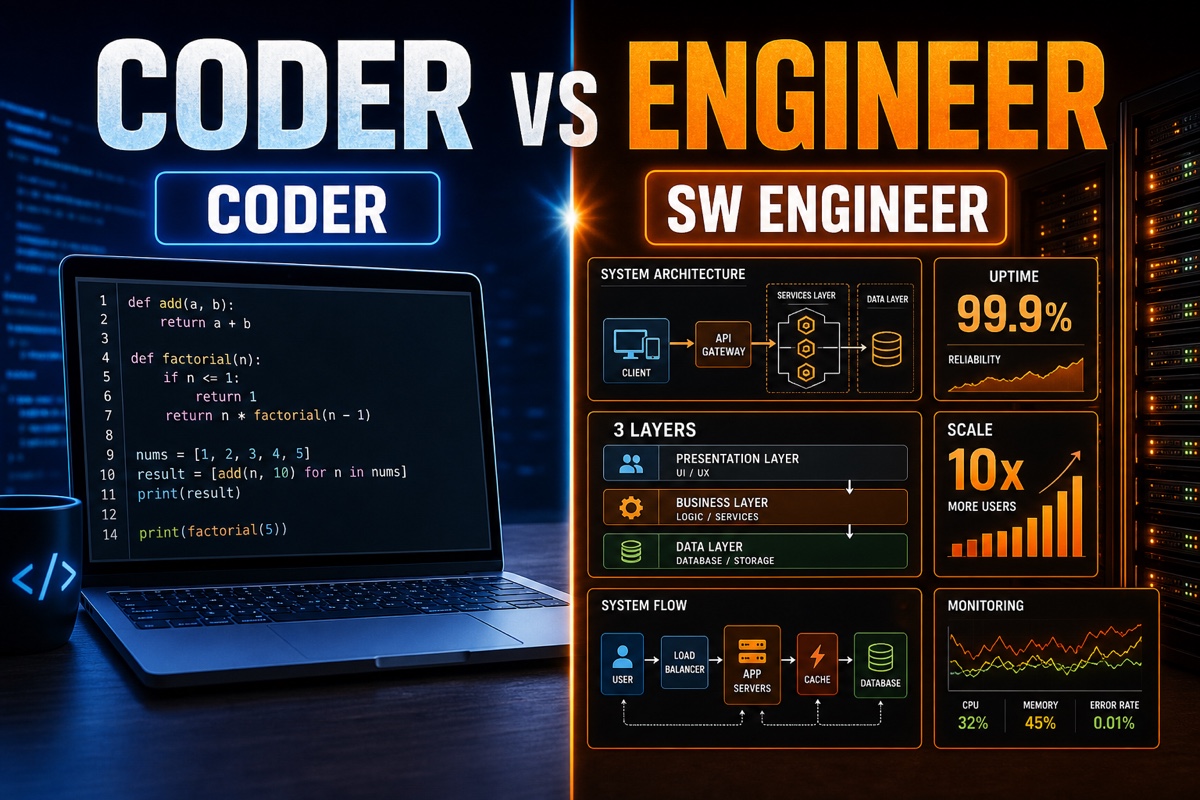
While studying software development, you may eventually wonder: “Am I a coder or a software engineer?”
The biggest difference isn’t whether you write code, but how far you take responsibility for the problem.
A coder implements code according to a given specification. A software engineer handles the entire process, from defining the problem through design, implementation, and maintenance.
This article summarizes the practical differences between the two roles, salary levels, and how to move from coder to engineer, along with lessons from my experience.
What’s the Difference Between a Coder and a Software Engineer?
Coders focus on translating defined requirements into code. When asked, “Make it save when this button is pressed,” they implement that feature precisely.
Software engineers ask questions one step earlier: “Why does it need to be saved? What if saving fails? Will this design handle 100,000 users?”
If coders answer “How should we build it?”, engineers also answer “What should we build, why, and with what architecture?”
Here’s a simple example: code that retrieves a user list.
// Coder: retrieve everything as requested
func getUsers() -> [User] {
    db.query("SELECT * FROM users")
}

// Engineer: account for the future when the data grows
func getUsers(page: Int = 1, size: Int = 20) -> [User] {
    let offset = (page - 1) * size
    return db.query("SELECT * FROM users LIMIT ? OFFSET ?", size, offset)
}
The feature is the same, but the code below anticipates the question, “What happens when there are one million users?”
What separates coders from engineers isn’t relative skill, but how far they take responsibility for the problem.
How Do They Differ in Practice?
Here’s a table summarizing the scope each role focuses on.
| Category | Coder | Software engineer |
|---|---|---|
| Primary focus | Feature implementation | Problem solving and system design |
| Scope of work | Given specifications | From requirements definition through deployment and operations |
| Key concerns | Working code | Scalability, maintainability, cost, and collaboration |
| Handling failures | Fixing bugs | Designing to prevent incidents |
| Communication partners | Within the development team | Product, design, and business teams as well |
Of course, the boundary between the two is not rigid in reality. The same person may work like a coder on one project and like an engineer on another.
However, as experience accumulates, the ability to see beyond code and understand the system becomes a core engineering skill.
How Large Is the Salary Difference?
Salary is determined more by what you do than by your role’s name. The following is a rough trend in the 2026 hiring market.
- Developers focused mainly on implementation: Because the barrier to entry is relatively low, salaries span a wide range.
- Engineers responsible for design and architecture: Supply is limited relative to demand, so the upper end of the salary range is higher.
U.S. market data shows that the median salary for software engineers is clearly higher than the average for general development roles. In Korea, the gap also tends to widen as people advance toward senior engineer or architect positions.
The key point is this: the harder a skill is to replace, the more valuable it becomes.
Implementing exactly what you’re told is easy to replace, but defining problems and designing systems is not.

How Do You Move from Coder to Engineer?
Here are three approaches that helped me.
- Ask “why” before writing code — Don’t accept requirements at face value; try to understand the context first.
- Imagine whether your code will still hold up six months from now, when the number of users has grown tenfold
- Actively participate in reviewing other people’s code — Your eye for design develops faster by studying someone else’s code.
You don’t need an impressive certification or a specific major. If you build the habit of thinking one step further about the small decisions you make every day, you’ll gradually develop an engineer’s perspective.
The difference between a coder and a software engineer is not relative skill, but the scope of responsibility.
If you’re working as a coder now, that’s a perfectly natural starting point on the path to becoming an engineer. Add just one more “why” to each line of code you write today.